Here is a question from the CBSE Class 4 Computational Thinking: A water lily doubles in size every day. On day 20, it covers the whole pool. On which day was the pool half covered?
If you said day 10, you halved 20. If you said day 19, you worked backwards from the rule. That second move is what Computational Thinking (CT) in Class 4 is about. CBSE has made it mandatory from the 2026–27 session, and it sits inside the Maths period.
So how is it different from maths? CT is maths, one step further. Maths asks for the answer. CT asks for a method that gives the right answer every time, on any input. Coding is that same method, written for a machine.
This page shows what CBSE Computational Thinking Class 4 covers, where children get caught out, and a chapter taught properly with worked examples.
The official CBSE Class 4 CT Student Handbook has 14 chapters, with the same names and order as the NCERT Class 4 Maths textbook. Each chapter has about 10 multiple-choice questions and one bonus puzzle at the end.
It is not a separate subject. CBSE fits it into Maths and The World Around Us (TWAU) periods, and suggests about 50 hours a year for Classes 3–5. For the circulars, hours and who teaches what, see our post on the CBSE CT & AI mandate for Classes 3–8.
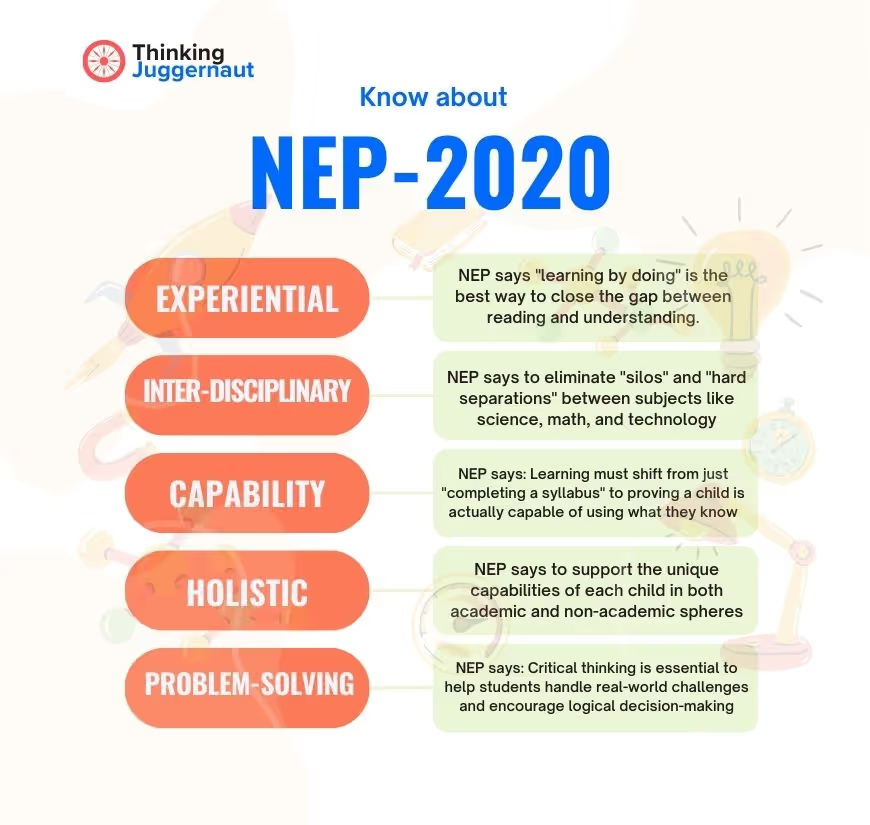
What changes from Class 3:
Each of these is a computational thinking question, and each has a tempting wrong answer.
None of these needs a computer. But each is a habit programmers depend on: work backwards, filter one condition at a time, track your totals, and read a condition exactly as written.
Chapter 3, Patterns Around Us, is about even and odd. Here is a CT question.
Shiv arranges his coins in 3 rows, with 5 coins in each row. His friend says: "You can pair up all your coins with none left over." Is the friend right?
Level 1: the maths answer. 3 × 5 = 15. The last digit is 5, so 15 is odd. One coin is left unpaired. The friend is wrong.
Level 2: the CT answer. Now change the numbers. 7 rows of 9 coins? 4 rows of 9? 10 rows of 5?
7 × 9 = 63, odd, so one is left. 4 × 9 = 36 and 10 × 5 = 50 are both even, so all pair up. See the pattern? A coin is left over only when both numbers are odd.
Why? If the number of rows is even, every row can be paired with another row. If the number of columns is even, every row pairs up within itself. Only odd rows and odd columns leave one coin over.
Now you have a rule that never needs the total. Try 1,001 rows of 3,003 coins. Both numbers are odd, so one coin is left over. You did not multiply anything.
That is the CT step. The child stopped answering one question and built a rule that answers every question of that type. Sums follow the same rules: odd + odd = even, even + odd = odd, even + even = even.
Level 3: the coding answer. A machine can be given the same rule:
if rows is odd and columns is odd: one coin is left over
else: all coins pair up
"If / else" is a condition. "And" joins two conditions into one. A program has to be right for every input, and here there are only four cases: odd–odd, odd–even, even–odd and even–even. Test one of each and you have tested every possible tray. Programmers use this idea all the time.
Start here. Do them on paper first, and ask for the steps, not just the answer.
Answers (try first!)
CBSE is implementing its CT & AI curriculum for Classes 3 to 8 from the 2026–27 session. In Class 4, it comes as CT inside Maths, using the handbook.
Yes, a step harder. Questions carry more clues at once, add swaps and conditions, and use bigger numbers. The four skills are the same: decomposition, pattern recognition, algorithmic thinking and abstract thinking.
No. Every question in the handbook is a paper puzzle. Coding-style thinking is the goal, but there is no code.
CBSE publishes a free Student Handbook and a Teacher Handbook for each class on its CT & AI page. Check with your school how it is scheduled and assessed.
It follows the same 14 chapters. Each chapter has a plain-language concept note, a step-by-step solved example, and graded questions (easy, medium and hard) with a solutions section. Our Class 4 CT workbook is meant to be used alongside the free CBSE handbook.
![[background image] electronics workbench](https://cdn.prod.website-files.com/6a92903fe4d791d3078b66cf/6aafb6b60bcf7b01e85a9082_6aab485222606e6d41bf7b34_ct.avif)
![[digital project] image of past client project on a magazine page](https://cdn.prod.website-files.com/6a92903fe4d791d3078b66cf/6ab076c8567046034b0ea0ed_6aafc4411aec75adbfe274e2_6aadd5f59d1ad9c61446f8bc_CT%2520Books%2520in%2520Series%2520TJ.jpeg)
![[digital project] image of past client project on a magazine page](https://cdn.prod.website-files.com/6a92903fe4d791d3078b66cf/6ab076c8567046034b0ea0e9_6aafc4857a28c5816adad287_6aaf3cc65dba02b8a0f7ea1b_Untitled%2520design%2520(3).avif)
Almost there!
We will confirm your order on WhatsApp
Order placed!
Thank you! You will receive a WhatsApp confirmation shortly.