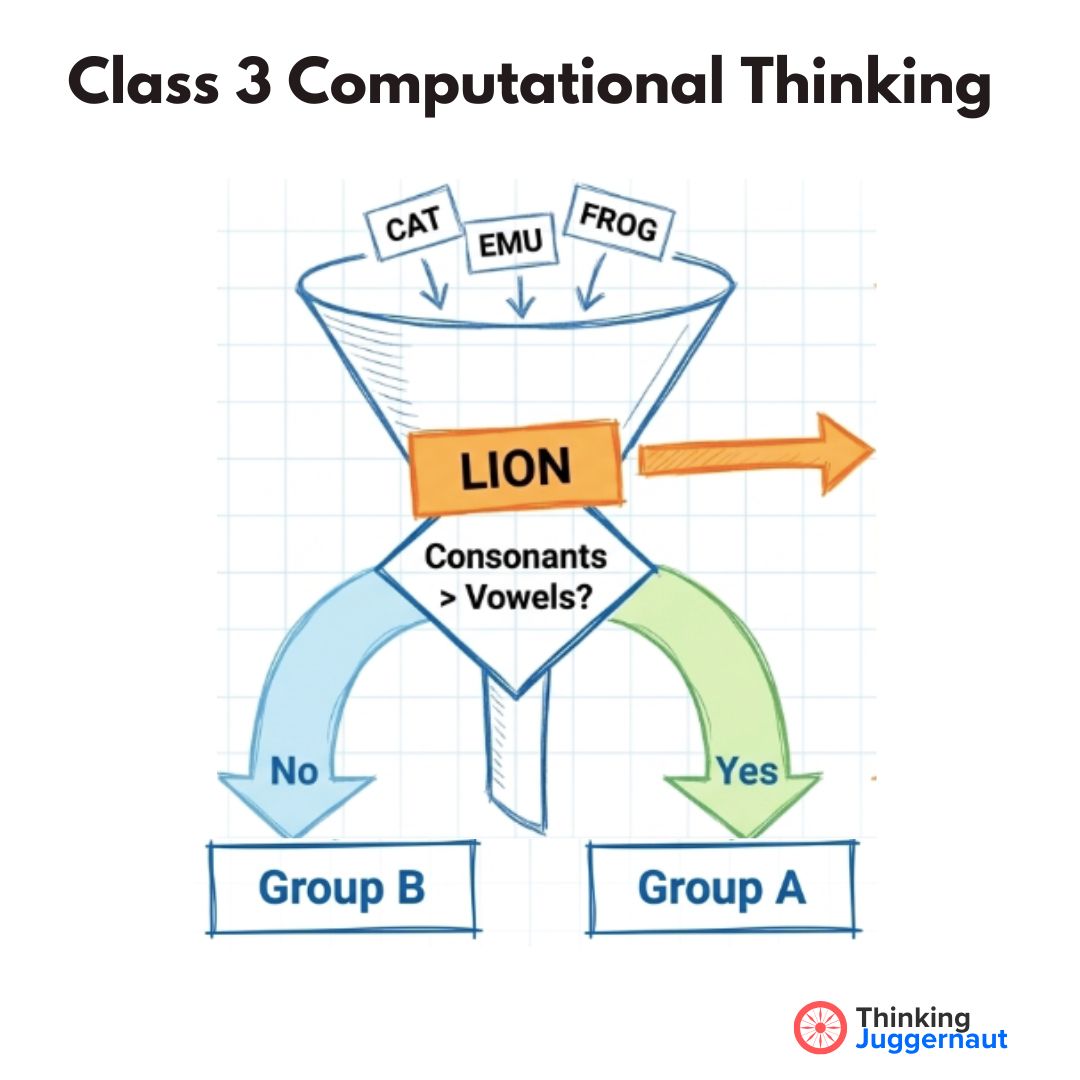
Computational Thinking (CT) is now part of Class 3. CBSE has made it mandatory from the 2026–27 session, and it sits inside the Maths period.
Why does it matter? Because CT is maths, one step further. Maths asks for the answer. CT asks for a method that gives the right answer every time, on any input. Coding is that same method, written so a machine can run it.
Class 3 is where a child first learns to build methods and logical thinking.
This page explains what CBSE Computational Thinking Class 3 covers, teaches two ideas from Chapters 1 and 2 with worked examples, and ends with things you can try this week.
The official CBSE Class 3 CT Student Handbook has 14 chapters. The chapter names and order are identical to the NCERT Class 3 Maths textbook, Maths Mela. Each chapter has about 10 multiple-choice questions and one bonus puzzle called the Thinking Spot.
It is not a separate subject. CBSE embeds it in Maths and The World Around Us (TWAU), and suggests about 50 hours a year for Classes 3–5. Assessment is puzzle-based written tests, group activities and a Teacher Observation Journal. The handbook is clear that the thinking process matters more than the right answer.
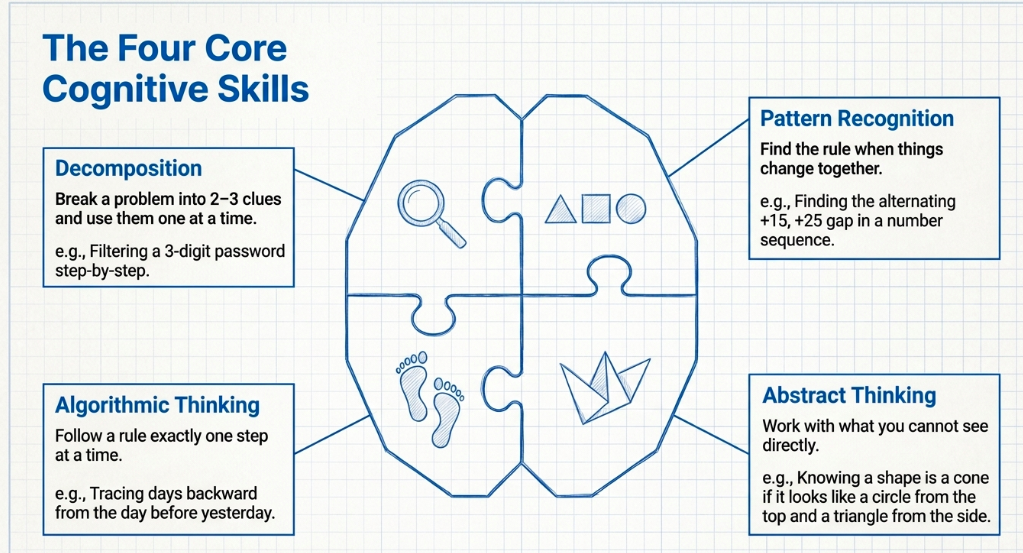
Every question tests one of four skills. Here is what each looks like in Class 3:
For hours, goals and how Classes 3–8 fit together, see our class-wise CBSE CT & AI curriculum breakdown. The CBSE handbook is free, so start there. Our Class 3 CT workbook follows the same 14 chapters if you want more practice.
This is Chapter 1, What's in a Name? The question:
Ravi sorts six animals into two groups. If a name has more consonants than vowels, it goes in Group A. Everything else goes in Group B.
CAT, LION, EMU, FROG, IBIS, SWAN
How many animals are in Group A?
Step 1: The maths. Count the vowels (A, E, I, O, U) and consonants (every other letter) in each name.
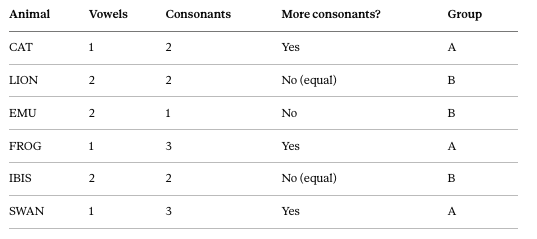
Group A has CAT, FROG and SWAN. Answer: 3.
Look at LION and IBIS. Vowels and consonants are equal, and "equal" is not "more". A child who glances at IBIS and thinks "lots of consonants" gets it wrong. Listing every letter and counting, every time, is what saves them. Never estimate. That is the first CT habit.
Step 2: The CT. Now write the steps so someone else could do this without seeing the animals.
That is an algorithm. Test it: hand these five steps to a friend with a brand new list (OWL, DUCK, HEN, GOAT, PIG). If your steps are right, they get the answer without asking you anything.
Step 3: The coding. Same steps, in the shape a computer wants:
for each name in the list:
count the vowels
count the consonants
if consonants > vowels: put it in Group A
else: put it in Group B
"For each" is a loop. "If / else" is a condition. In Scratch (free, from MIT) these are the repeat and if-else blocks. In Python it is about five lines.
One more thing. A computer follows the steps exactly, so it makes the LION mistake for you. Write ≥ instead of > and LION jumps into Group A. That > versus ≥ slip is one of the most common bugs in real programs. A Class 3 child meets it with a lion and an ibis.
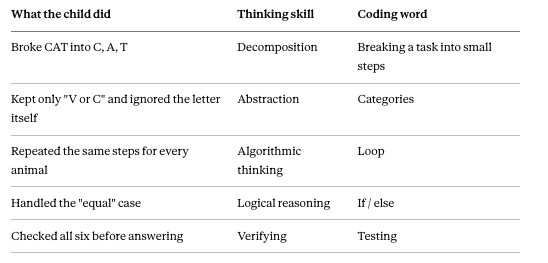
Here is what that one question trained:
Chapter 2, Toy Joy, is about 3D shapes: cubes, cones, cylinders. Here is a pattern question.
A shelf holds Cube, Cone, Cylinder, Cube, Cone, Cylinder... and keeps repeating. Which shape is at position 14?
Most children write out the shapes from 1 to 14. That works, and it is a fine start. Now ask: what about position 100? Position 1,000? Writing them out stops working. This is where CT begins: find a method that works for any position.
Answer: Cone.
Remainder 0 is the trap. It does not mean "nothing". It means the position lands exactly at the end of a cycle. Position 12 is 4 complete cycles, so it is a Cylinder. Now test the method on position 100: 100 ÷ 3 = 33 remainder 1, so it is a Cube. Check: 99 ends the 33rd cycle (a Cylinder), so 100 starts a new one with a Cube.
The same concept can be applied wherever something repeats: whose turn it is in a four-player game, which colour comes next in a repeating light sequence, which animation frame to show. It is also a calendar trick. What day is it 100 days from now? Remainder of 100 by 7 = 2, so it is the same as two days from now. Chapter 13 (Time Goes On) is full of these.
Start here. Do them on paper first, and ask for the steps, not just the answer.
Answers (try first!)
CBSE is implementing its CT & AI curriculum for Classes 3 to 8 from the 2026–27 session. In Class 3, it comes as CT inside Maths.
No. Every question in the Class 3 handbook is a paper puzzle. Coding-style thinking is the goal, but there is no code.
The Maths teacher, alongside the Maths Mela chapters. The handbook is written as a companion to the textbook.
CBSE publishes a free Student Handbook and a Teacher Handbook for each class on its CT & AI page. Check with your school how it is scheduled and assessed.
It follows the same 14 chapters. Each topic starts with a short concept explanation and solved examples that show the thinking, not just the answer. Then come 200+ graded practice questions with solutions, plus hands-on activities. Use it alongside the free CBSE handbook.
![[background image] electronics workbench](https://cdn.prod.website-files.com/6a92903fe4d791d3078b66cf/6aafb6b60bcf7b01e85a9082_6aab485222606e6d41bf7b34_ct.avif)
![[digital project] image of past client project on a magazine page](https://cdn.prod.website-files.com/6a92903fe4d791d3078b66cf/6aafc4411aec75adbfe274e2_6aadd5f59d1ad9c61446f8bc_CT%20Books%20in%20Series%20TJ.jpg)
![[digital project] image of past client project on a magazine page](https://cdn.prod.website-files.com/6a92903fe4d791d3078b66cf/6aafc4857a28c5816adad287_6aaf3cc65dba02b8a0f7ea1b_Untitled%20design%20(3).avif)
Almost there!
We will confirm your order on WhatsApp
Order placed!
Thank you! You will receive a WhatsApp confirmation shortly.