.jpg)
A Class 5 CT question looks like a Maths question. It is not. The Maths question asks what is the answer? The CT question asks can you read the conditions, split them up, and show that your answer must be right?
That difference is the whole reason CBSE has added Computational Thinking (CT) to Class 5 from the 2026–27 session. It sits inside the Maths period, not as a separate subject.
This page covers what Computational Thinking Class 5 includes, walks through two solved examples step by step, and explains how this kind of practice builds logical thinking.
The CBSE Class 5 CT Student Handbook (first edition, March 2026) follows the NCERT Class 5 Maths chapter order, so it works chapter by chapter as a companion to the textbook.
The 15 chapters: We the Travellers – I, Fractions, Angles as Turns, We the Travellers – II, Far and Near, The Dairy Farm, Shapes and Patterns, Weight and Capacity, Coconut Farm, Symmetrical Designs, Grandmother's Quilt, Racing Seconds, Animal Jumps, Maps and Locations, and Data Through Pictures.
Each chapter has 10 questions and a bonus puzzle called the Thinking Spot. About 50 hours a year is suggested across Classes 3–5, built into Maths and The World Around Us. Assessment is written CT puzzles, group activities, and a Teacher Observation Journal. The handbook says the process of thinking matters more than the correct answer.
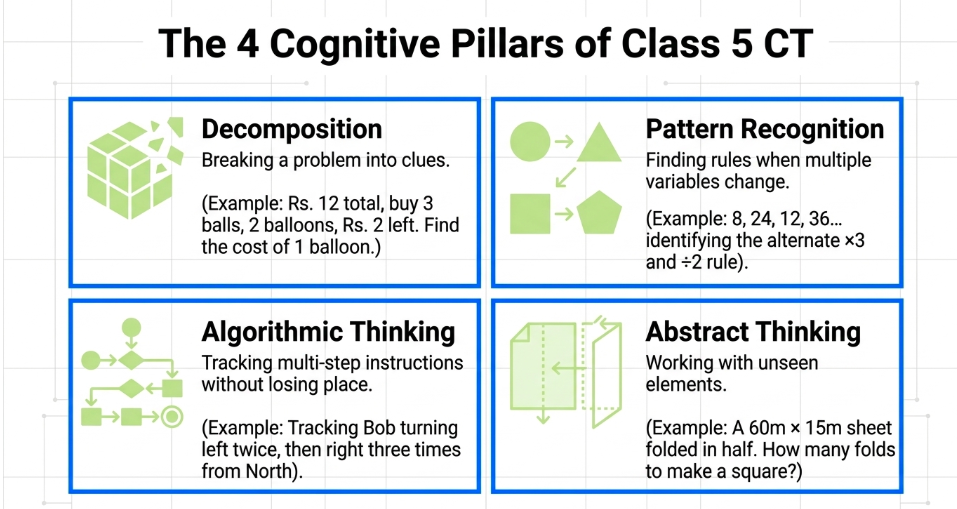
Every question tests one of four skills. Here is how they show up:
Want the bigger picture of how Classes 3–8 fit together? See our class-wise CBSE CT & AI curriculum breakdown.
Q. A 5-digit number is formed using the digits 1, 2, 3, 4 and 6, each used exactly once. The ten-thousands digit is even, the units digit is odd, and the hundreds digit is greater than the tens digit. How many such numbers are possible?
a) 6 b) 8 c) 18 d) 24
Step 1: Decompose. Break the problem into its three conditions.
Step 2: List the valid (ten-thousands, units) pairs. The ten-thousands digit must be even, the units digit odd, and no digit repeats.
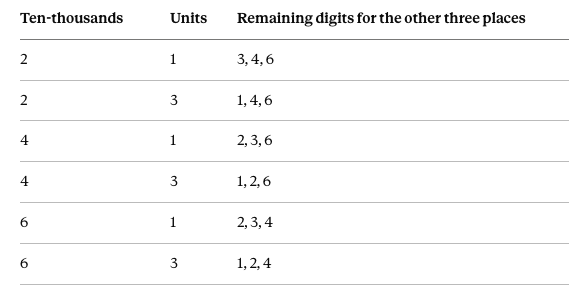
That gives 6 valid pairs.
Step 3: Apply Condition C. For each row, the 3 remaining digits fill the thousands, hundreds and tens places. The thousands digit can be any of the 3, so 3 choices. The other 2 digits go in the hundreds and tens places. Since all digits are different, exactly 1 out of 2 arrangements has hundreds > tens. So each pair gives 3 × 1 = 3 numbers.
Step 4: Verify with one case. Ten-thousands = 2, units = 1, remaining 3, 4, 6:
3 numbers for this pair ✓
Step 5: Calculate. Total = 6 pairs × 3 = 18.
Answer: c) 18
Skill demonstrated: Decomposition. Three conditions at once, broken into independent rules, counted separately, then combined.
Q. A sweet shop has some laddoos. In the morning it sells half. In the afternoon it sells half of what remains. By evening, 6 laddoos are left. A student claims the shop started with 24. Is the student correct?
a) Yes, the student is correctb) No, the shop started with 12c) No, the shop started with 36d) No, the shop started with 48
Step 1: Work backwards. Evening leftover = 6. These are what remained after the afternoon sale.
Step 2: Undo the afternoon. The afternoon sale took half of what was there before it. So before the afternoon: 6 × 2 = 12.
Step 3: Undo the morning. The morning sale took half of the original stock. So before the morning: 12 × 2 = 24.
Step 4: Verify going forward. Start 24. Morning: 12 sold, 12 remain. Afternoon: 6 sold, 6 remain ✓
Answer: a) Yes, the student is correct.
Skill demonstrated: Algorithmic thinking. Working backwards, one step at a time.
Solving these two questions is not the point. Look at what the child was made to do along the way.
They separated the rules before calculating. In Example 1, the child did not start with 5 digits and hope. They wrote three conditions on paper and tested each one separately. This is the habit behind reading any tricky instruction properly: a form, a rulebook, an exam question with three "and" clauses.
They used structure instead of listing everything. In Step 3, they did not write out all the arrangements. They saw that for any two different digits, exactly one order has the bigger digit first. That is reasoning, not counting.
They reversed a process. In Example 2, the story runs forward but the question is asked from the end. Undoing each step (double instead of halve) is a different mental move from doing each step. Children who can do both are much harder to fool with word problems.
They checked their own answer. Both examples end with a verify step. In Example 1 they checked one case by hand. In Example 2 they ran the story forward from 24. A child who verifies does not need someone else to tell them if they are right. This is the habit we would pick over any single skill.
To be clear about the claim: this is practice, not magic. A child who works 15 chapters of these becomes faster and more careful at reading conditions and testing an answer, and that carries into Maths, Science and everyday reasoning. CBSE positions CT as the foundation for later learning in AI, which is why it starts here, on paper, well before any computer is involved.
These are the habits the workbook drills, chapter after chapter:
Attempt on paper first. Write the steps, not just the answer. Then do the verify step, going forward from your answer, to check it yourself.
(Chapter 1) A 5-digit number is formed using the digits 1, 2, 3, 4 and 5, each used exactly once. What is the digit in the hundreds place of the third-largest such number? a) 4 b) 3 c) 5 d) 2
(Chapter 2) In a fruit basket there are some oranges. The first person takes half the oranges. The second person takes half of what remains. The third takes half of what remains after that. The fourth person finds only 2 oranges and takes them all. How many oranges were in the basket at the start? a) 16 b) 24 c) 32 d) 8
(Chapter 2) Riya, Siya and Tiya each have the same number of marbles. Statement: "Two-thirds of Riya's marbles are blue." Which of these CAN be concluded? a) Riya has 30 blue marbles.b) One-third of Riya's marbles are not blue.c) All three friends together have more blue marbles than non-blue marbles.d) Siya has more blue marbles than Riya.
(Chapter 3) Arjun faces East. He takes a ½ anticlockwise turn, then a ¼ clockwise turn, then another ¼ anticlockwise turn. Which direction does he face finally? a) North b) East c) South d) West
No answers here, on purpose. Let the child argue for their option and defend it.
Planning CT across Classes 3–8 for your school? See how we work with schools. If you want graded practice on each chapter, with the same kind of step-by-step solved examples as above, our Class 5 CT workbook follows the same 15 chapters. Use it alongside the free CBSE handbook.
![[background image] electronics workbench](https://cdn.prod.website-files.com/6a92903fe4d791d3078b66cf/6aafb6b60bcf7b01e85a9082_6aab485222606e6d41bf7b34_ct.avif)
![[digital project] image of past client project on a magazine page](https://cdn.prod.website-files.com/6a92903fe4d791d3078b66cf/6ab076c8567046034b0ea0ed_6aafc4411aec75adbfe274e2_6aadd5f59d1ad9c61446f8bc_CT%2520Books%2520in%2520Series%2520TJ.jpeg)
![[digital project] image of past client project on a magazine page](https://cdn.prod.website-files.com/6a92903fe4d791d3078b66cf/6ab076c8567046034b0ea0e9_6aafc4857a28c5816adad287_6aaf3cc65dba02b8a0f7ea1b_Untitled%2520design%2520(3).avif)
Almost there!
We will confirm your order on WhatsApp
Order placed!
Thank you! You will receive a WhatsApp confirmation shortly.