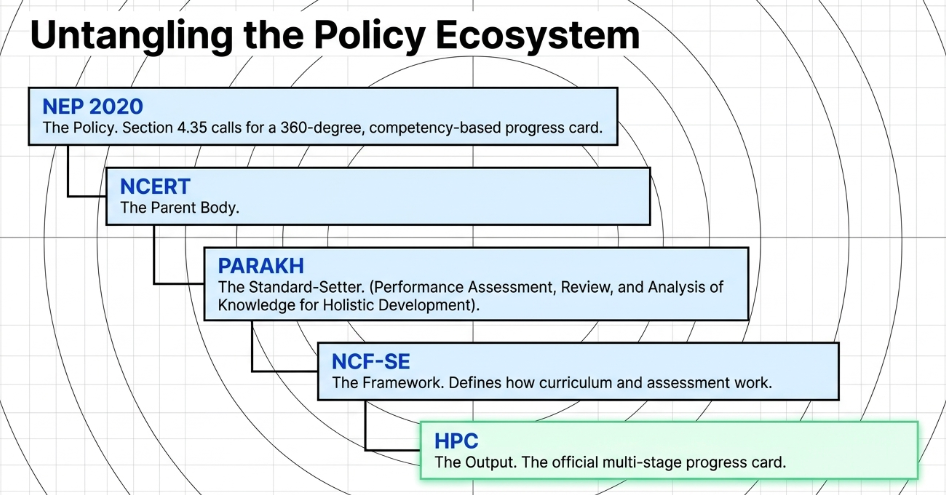
The Holistic Progress Card (HPC) is NCERT's replacement for the marks-only report card. It was built by PARAKH — Performance Assessment, Review, and Analysis of Knowledge for Holistic Development, a standard-setting body under NCERT — to implement Section 4.35 of NEP 2020, which calls for a 360-degree progress card covering a child's cognitive, affective, and psychomotor development, not marks alone.
Four stage-wise HPCs exist because assessment needs differ by age — they follow NEP's 5+3+3+4 school structure.
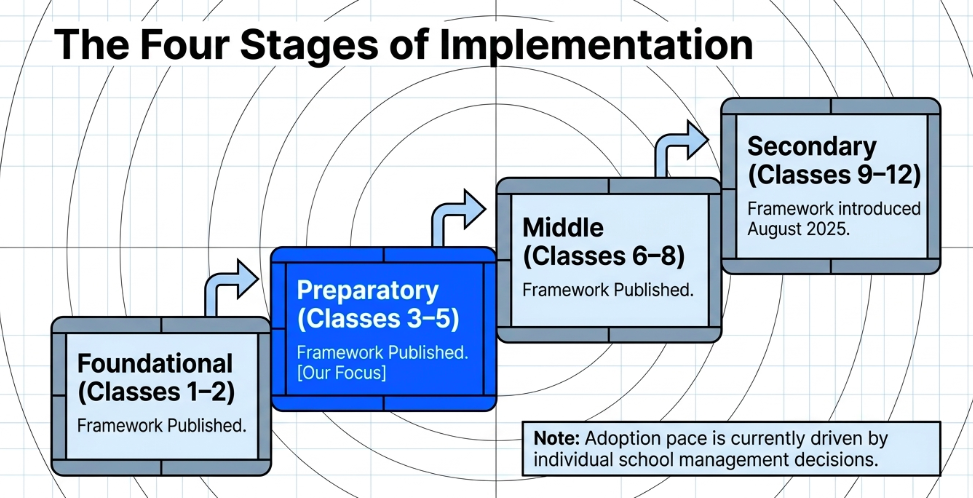
NCERT and PARAKH have published and recommend the HPC across all four stages, but it isn't a blanket mandate the same way a CBSE syllabus circular is. Adoption pace depends on your school's own management — some have already made HPC mandatory for internal reporting, others are still running it alongside the traditional report card, or transitioning gradually. If a circular has landed on your desk this term, it usually means your management has decided to move now rather than wait.
The old report card asked one question: how much did the student score. The HPC pulls from four different sources instead.
At the Preparatory Stage specifically, a student portfolio — an actual collection of the child's work over the term — is also a formal part of the HPC, not just a nice-to-have. At the Middle Stage, students additionally fill an "ambition card" — their goals for the year, what they want to improve, and the habits needed to get there.
A teacher we spoke with described a student — call him Arjun — who was a C-grade student in Math and Science on paper. Stop at the mark sheet, and the obvious next step is more coaching — another tuition class, more worksheets, a stricter routine.
But outside the marks column, Arjun was the one who talked fifteen classmates into pooling pocket money for a stationery stall at the school fair — and it turned a profit. He settled playground disputes before a teacher even noticed there was one. Half the class copied his way of organising a group project, not because he did the work for them, but because he was the one who structured it.
None of that shows up on a mark sheet. All of it belongs on an HPC — under self-assessment, peer feedback, and a teacher's remark on collaboration and initiative.
Ask what school is actually for. If the only goal is exam scores, a coaching centre does that job faster and cheaper. School exists to produce people — and some of those people will start businesses, invent things, lead teams, or hold a room the way Arjun already could at twelve. The HPC is the first document that puts that on record, instead of leaving it as something only his class teacher happened to remember.
For the exact differences from the format you're used to, see HPC vs Traditional Report Card.
Expect 6–10 pages depending on stage and subject count.
Schools issuing marks or grades alongside the HPC typically print those as a supplementary table, not a replacement.
The usual worry when a new form lands on a teacher's desk is: one more thing to observe, on top of an already full day. That's not really what's being asked here.
A teacher who's spent a term with Arjun already knew he was a natural organiser and a reluctant Math student — that wasn't new observation, that was just Tuesday. What's new is putting it down in a structured, defensible format instead of it staying a comment made once in a staffroom and never written anywhere.
The real time cost isn't the knowing — it's formatting six to ten pages of it, per student, by hand. That's the part worth automating, not the noticing.
The HPC sits inside the National Curriculum Framework for School Education (NCF-SE), which PARAKH also shaped. For the body itself, read What Is PARAKH? For the policy context behind why this exists, see our NEP 2020 explainer.
Schools report the same bottleneck: not confusion over the framework, but the hours it takes to format one multi-page document per student. Our free generators handle the formatting and print a ready A4 PDF — a Preparatory Stage HPC Generator for Classes 3–5, and a Middle Stage HPC Generator for Classes 6–8.
Preparatory Stage HPC Generator — Classes 3–5
Any field left blank prints as a clean template, so a rushed report is still a usable one.
What does HPC stand for?
HPC stands for Holistic Progress Card — the NEP 2020-aligned assessment document developed by PARAKH, NCERT, replacing the traditional marks-only report card.
Is HPC compulsory for CBSE schools?
Not universally, yet. NCERT/PARAKH has published and recommends the HPC for all four school stages, but whether it's mandatory at your school depends on your management's own rollout decision — many schools are adopting it now, others are still transitioning.
What does Thinking Juggernaut for schools help with? See what we provide for schools.
![[background image] electronics workbench](https://cdn.prod.website-files.com/6a92903fe4d791d3078b66cf/6aafb6b60bcf7b01e85a9082_6aab485222606e6d41bf7b34_ct.avif)
![[digital project] image of past client project on a magazine page](https://cdn.prod.website-files.com/6a92903fe4d791d3078b66cf/6ab076c8567046034b0ea0ed_6aafc4411aec75adbfe274e2_6aadd5f59d1ad9c61446f8bc_CT%2520Books%2520in%2520Series%2520TJ.jpeg)
![[digital project] image of past client project on a magazine page](https://cdn.prod.website-files.com/6a92903fe4d791d3078b66cf/6ab076c8567046034b0ea0e9_6aafc4857a28c5816adad287_6aaf3cc65dba02b8a0f7ea1b_Untitled%2520design%2520(3).avif)
Almost there!
We will confirm your order on WhatsApp
Order placed!
Thank you! You will receive a WhatsApp confirmation shortly.