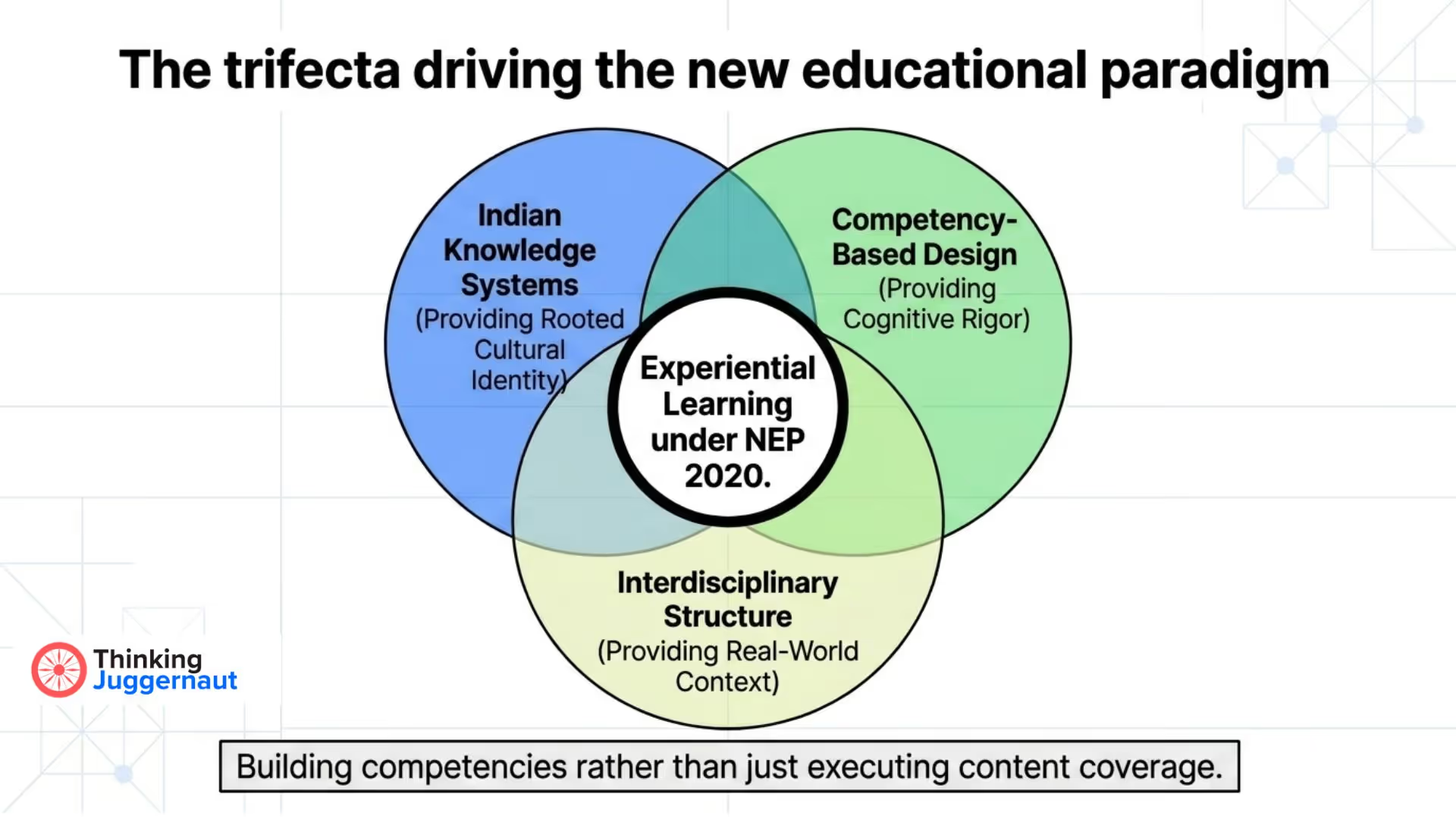
Session 2026–27 marks the most significant overhaul of Class 9 textbooks in over two decades. NCERT has introduced entirely new book for Mathematics — not revisions, but ground-up rewrites aligned with NEP 2020 and the National Curriculum Framework for School Education (NCF-SE 2023). New Books for English, Sanskrit and Science as well.
Mathematics: Ganita Manjari Part 1
The new Class 9 Mathematics textbook is called Ganita Manjari — replacing the earlier 12-chapter book with 8 redesigned chapters. The approach moves from the older pattern of formula → worked example → practice problems toward one where students encounter a problem first, reason through it, and arrive at the concept. This mirrors the inquiry-based style already introduced in the new Class 6, 7, and 8 NCERT textbooks — Ganita Prakash — so students who have been through the new middle school books will find this a natural continuation.
The 8 chapters in Ganita Manjari Part 1 are:
Chapters are interconnected — ideas from Chapter 1 reappear in Chapter 2, Chapter 3 supports Chapter 4, Chapter 8 draws on Chapter 2. The textbook is built for progressive learning rather than chapter-by-chapter isolation.
Indian Knowledge Systems at the Core
One of the most distinctive features of Ganita Manjari is how deeply it roots mathematical concepts in India's intellectual history. Chapter 1, for example, does not begin with the Cartesian plane — it begins with the grid-based city planning of the Sindhu-Sarasvatī Civilisation, then traces how coordinate thinking evolved through Baudhāyana, Āryabhaṭa, and Brahmagupta before arriving at formal definitions.
The distance formula, for instance, is presented as an application of the Baudhāyana–Pythagoras Theorem. Students are expected to understand the derivation from this lineage — not memorise a standalone result. Brahmagupta's formalisation of zero and negative numbers as algebraic entities is framed as foundational to the four-quadrant coordinate plane. Āryabhaṭa's replacement of the Greek system of "chords" with "sines" is introduced in the context of trigonometric simplification.
This is the same Indian Knowledge Systems (IKS) thread that runs through the new Class 6–8 textbooks — and Ganita Manjari extends it into secondary mathematics deliberately and systematically.
If you want students to engage with IKS through hands-on activities — not just read about it — the Thinking Juggernaut Applied Math Project Kit is designed for exactly this kind of exploratory, culturally rooted mathematical learning.
Assessment Changes
Exams based on Ganita Manjari test differently. The question types are: concept-based MCQs (testing understanding, not recall), written reasoning questions (short justifications in words), real-life application problems, and proof-based questions. This is consistent with the competency-based assessment framework introduced across all new NCERT books.
What About Class 10?
Class 10 textbooks are unchanged for 2026–27. According to NCERT's official advisory (released 17 March 2026), new textbooks for Classes 10 and 11 have been deferred to the 2027–28 academic session. Students currently in Class 10 continue with the existing NCERT books across all subjects.
What does change for Class 10 in 2026–27 is the CT & AI module. As we covered in our CBSE CT & AI mandate post, NCERT is providing Computational Thinking and AI modules for Classes 9–12 this session, to be completed as internal assessment components. This applies to Class 10 students now.
Looking ahead: When Class 10 textbooks do arrive in 2027–28, they are expected to continue the same trajectory — Indian Knowledge Systems integration, competency-based learning, interdisciplinary structure — building directly on what Class 9 students are learning now.
The Larger Rollout
The 2026–27 changes for Class 9 are part of a phased rollout:
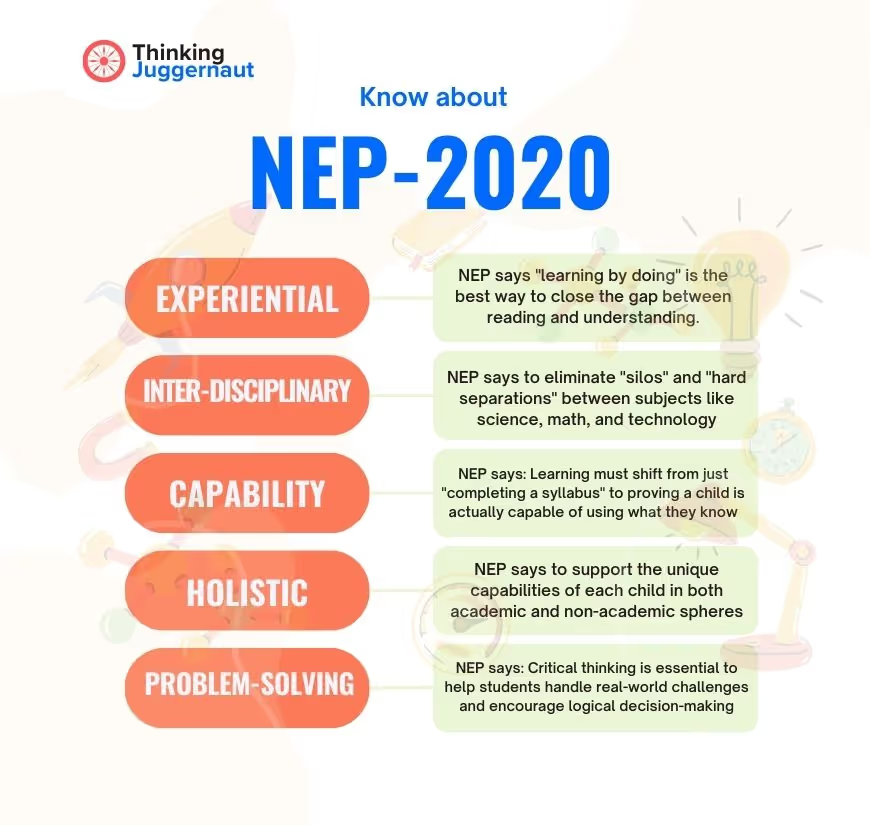
The thread connecting all of these is the same: rooting learning in Indian knowledge and civilisation, replacing rote recall with reasoning and application, and building competencies rather than content coverage. The NEP 2020 framework that drives this shift, and what experiential learning looks like in practice under NEP, are worth reading alongside these textbook changes.
Download the New Textbooks
All are free to download from ncert.nic.in.
Source Documents
![[background image] electronics workbench](https://cdn.prod.website-files.com/6867e17b7728d4dad1984de4/6971df3fc68f17192e35e18a_NEP%202020%20Experiential%20Learning.avif)
![[digital project] image of past client project on a magazine page](https://cdn.prod.website-files.com/6867e17b7728d4dad1984de4/69e45a828d0330ffb6ea1e34_Screenshot%202026-04-19%20at%2010.00.43%20AM.avif)
![[digital project] image of past client project on a magazine page](https://cdn.prod.website-files.com/6867e17b7728d4dad1984de4/69e4675ba1a912bed4dafb2e_Screenshot%202026-04-19%20at%2010.55.23%20AM.avif)
Almost there!
We will confirm your order on WhatsApp
Order placed!
Thank you! You will receive a WhatsApp confirmation shortly.