Download free Class 4 perimeter and area worksheet with answers. Contains 24 practice problems covering perimeter calculations, area measurements, rectangles, squares, word problems, and challenge questions. This printable PDF includes visual diagrams, step-by-step solutions, and assessment rubrics.
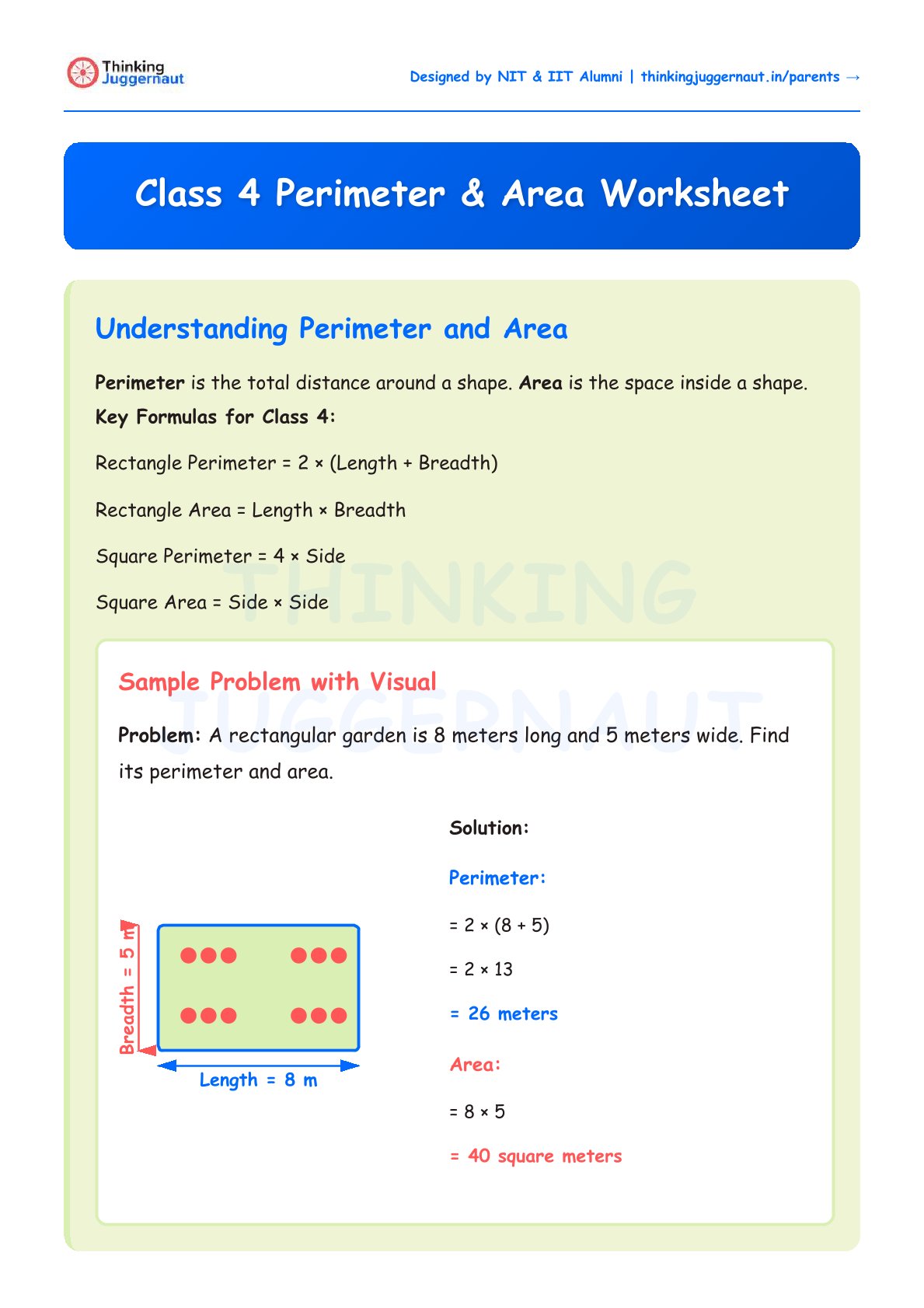
Understanding Perimeter and Area
Perimeter is the total distance around the outside of a shape. Think of it as walking around the boundary of a garden or playground.
Area is the amount of space inside a shape. Think of it as the carpet needed to cover a floor or paint needed to cover a wall.
Key Formulas for Class 4:
Rectangle Formulas:
Perimeter = 2 × (Length + Breadth)
Area = Length × Breadth
Square Formulas:
Perimeter = 4 × Side
Area = Side × Side
Important Units:
Perimeter is measured in: cm, m, km (length units)
Area is measured in: sq cm, sq m, sq km (square units)
Solved Example: Step by Step
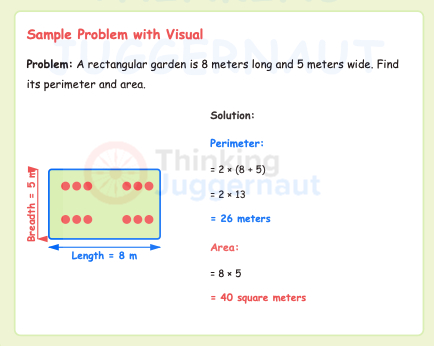
Problem: A rectangular garden is 8 meters long and 5 meters wide. Find its perimeter and area.
Solution:
Step 1 - Find Perimeter:
Formula: Perimeter = 2 × (Length + Breadth)
= 2 × (8 + 5)
= 2 × 13
= 26 meters
Step 2 - Find Area:
Formula: Area = Length × Breadth
= 8 × 5
= 40 square meters
Answer: Perimeter is 26 meters and Area is 40 square meters.
Worksheet Problem Types
This PDF includes varied question formats:
Basic Calculations: Find perimeter of rectangle with length 10 cm and breadth 6 cm
Square Problems: Find area of a square with side 7 cm
Fill in the Blanks: Area of rectangle = Length × _____
True/False: The perimeter of a square with side 5 cm is 20 cm
Word Problems: A rectangular classroom is 8 meters long and 6 meters wide. How many square meters of carpet is needed?
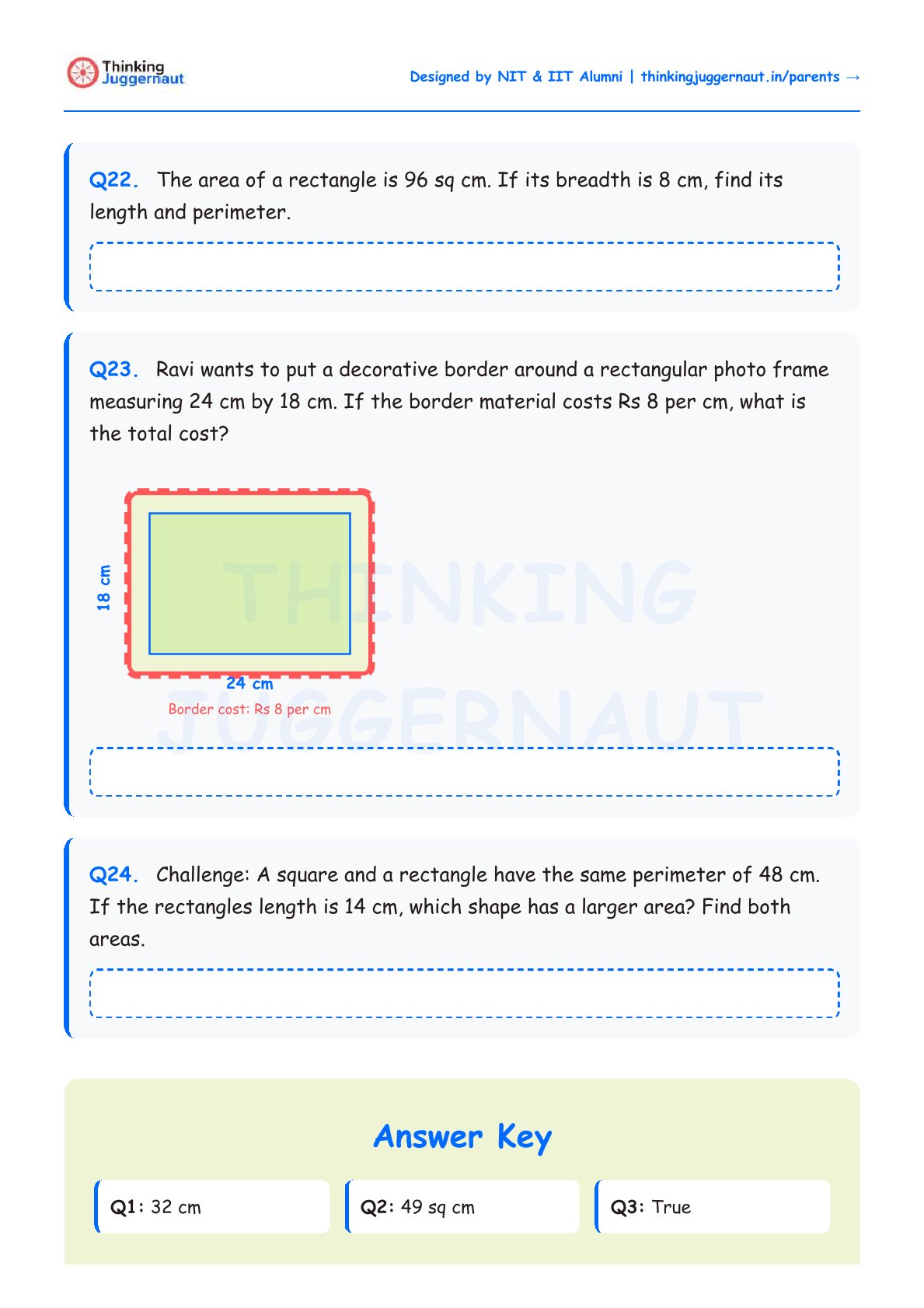
Cost Calculations: Find the cost of fencing a park at Rs 15 per meter
Reverse Calculations: If a square has perimeter 24 cm, what is the length of one side?
Challenge Problems: A square and rectangle have the same perimeter - which has larger area?
Common Mistakes & Learning Tips
Frequent Errors to Avoid:
Mixing Up Perimeter and Area: Perimeter adds all sides, area multiplies length and width. Remember: perimeter is the fence around a garden, area is the grass inside.
Wrong Units: Using 'cm' for area instead of 'sq cm'. Area always needs square units (sq cm, sq m).
Forgetting to Multiply by 2: In rectangle perimeter formula, students often forget the "2 ×" part. Rectangle perimeter = 2 × (L + B), not just (L + B).
Adding Instead of Multiplying for Area: Area is Length × Breadth, not Length + Breadth.
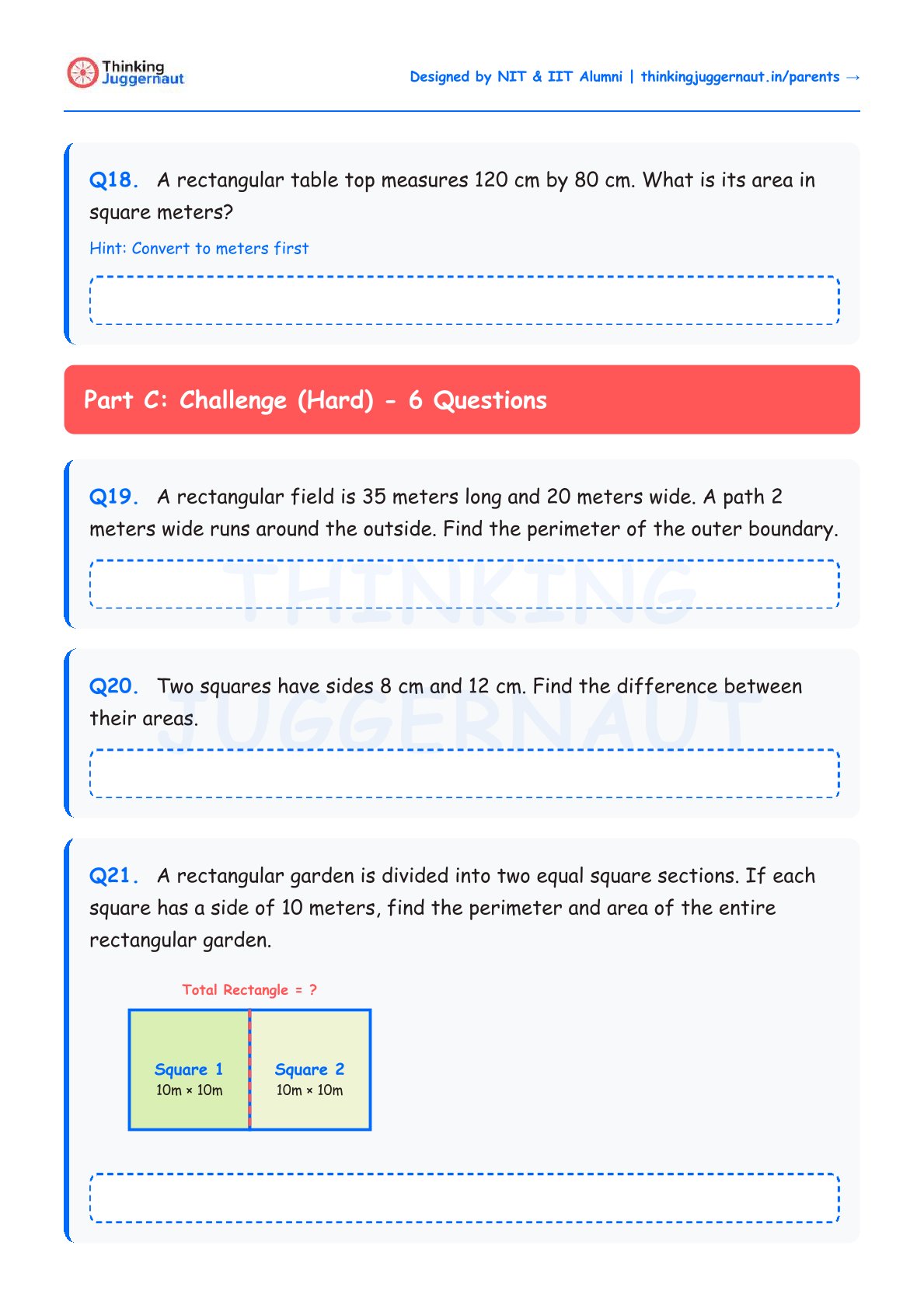
Not Converting Units: When asked for area in square meters but dimensions given in centimeters, always convert first.
5 Essential Tips for Mastery:
Draw the Shape: Always draw a diagram and label all sides with their measurements. Visual representation prevents confusion between length and breadth.
Remember the Key Difference: Perimeter is a LINE (measured in cm, m), Area is a SURFACE (measured in sq cm, sq m). If you're counting squares inside, it's area. If you're walking around the edge, it's perimeter.
Square is Special: For squares, all four sides are equal, so Perimeter = 4 × Side is much quicker than adding all four sides separately.
Check Your Units: Perimeter uses single units (cm, m), Area uses square units (sq cm, sq m). Wrong units = wrong answer, even if the number is correct.
Use Real-Life Examples: Practice with objects around you - find the perimeter of your notebook, area of your room floor, or perimeter of a photo frame. Real-world practice makes formulas stick.
Assessment Guide
Total Questions: 24 | Total Marks: 24
Score: 22–24 (Outstanding! 🌟)
Mastery Level: Complete understanding of perimeter and area
Next Step: Try problems with composite shapes or Class 5 concepts
Score: 18–21 (Excellent! ⭐)
Strong Understanding: Solid grasp of both concepts
Next Step: Focus on word problems and unit conversion challenges
Score: 14–17 (Very Good! ✓)
Good Foundation: Core formulas understood
Next Step: Practice more rectangle and square problems, review formula application
Score: 10–13 (Good Effort! 💪)
Developing Skills: Basic concepts in place, needs reinforcement
Next Step: Memorize formulas, practice with visual diagrams
Score: Below 10 (Keep Practicing! 📚)
Building Foundation: More practice needed on fundamentals
Next Step: Review difference between perimeter and area, practice basic problems daily with drawings