⭐ Answer Key included!
Master factors and multiples with this Class 4 worksheet. 24 questions covering factor identification, multiples, prime numbers, and real-life packing problems. Complete solutions and learning tips included.
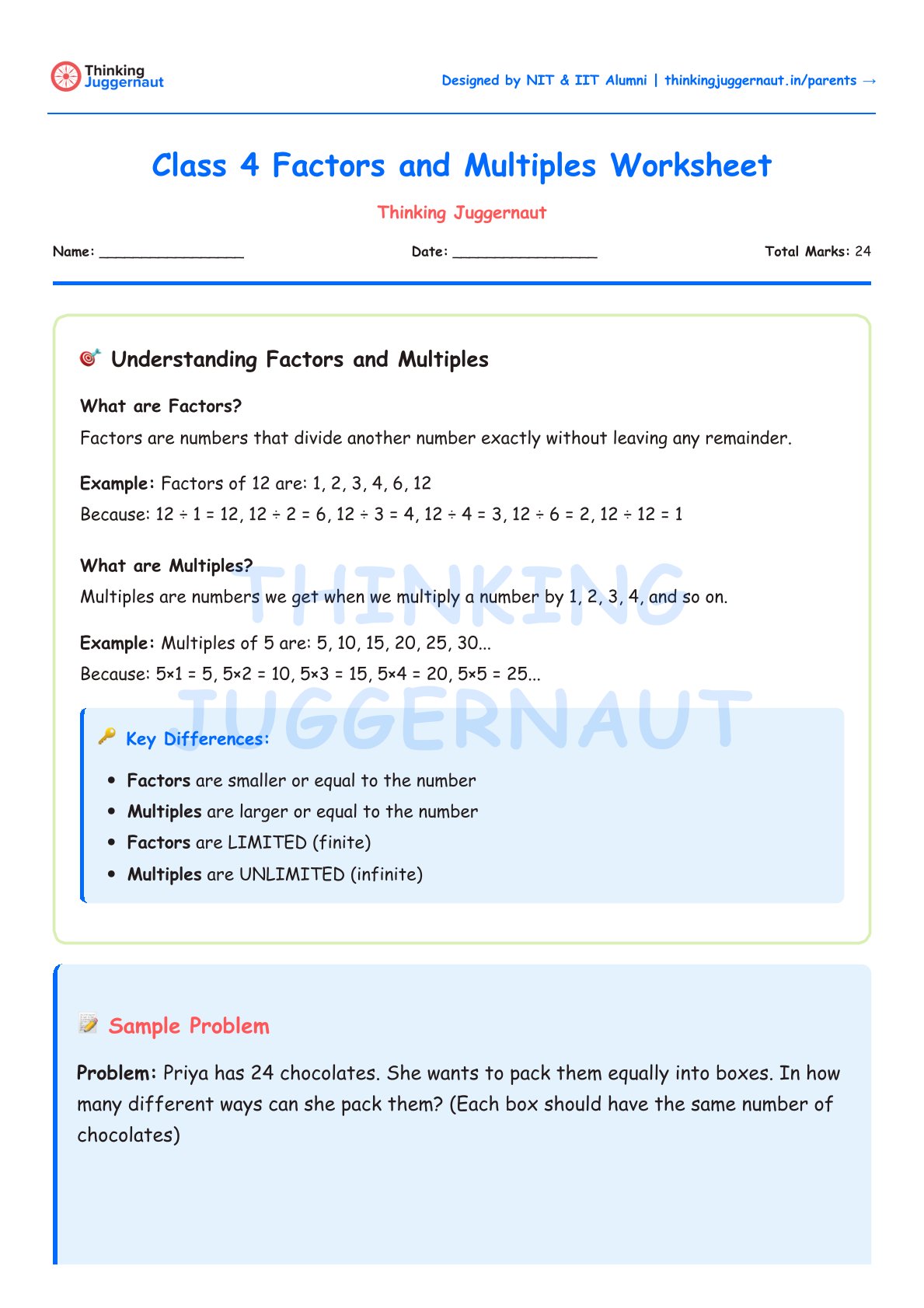
Factors are numbers that divide another number exactly without leaving any remainder.
Example: Factors of 12 are: 1, 2, 3, 4, 6, 12
Because: 12 ÷ 1 = 12, 12 ÷ 2 = 6, 12 ÷ 3 = 4, 12 ÷ 4 = 3, 12 ÷ 6 = 2, 12 ÷ 12 = 1
Multiples are numbers we get when we multiply a number by 1, 2, 3, 4, and so on.
Example: Multiples of 5 are: 5, 10, 15, 20, 25, 30...
Because: 5×1 = 5, 5×2 = 10, 5×3 = 15, 5×4 = 20, 5×5 = 25...
Factors are smaller or equal to the number
Multiples are larger or equal to the number
Factors are LIMITED (finite)
Multiples are UNLIMITED (infinite)
Problem: Priya has 24 chocolates. She wants to pack them equally into boxes. In how many different ways can she pack them?
Solution:
We need to find all the factors of 24 (numbers that divide 24 exactly)
24 ÷ 1 = 24 (1 box of 24 chocolates)
24 ÷ 2 = 12 (2 boxes of 12 chocolates)
24 ÷ 3 = 8 (3 boxes of 8 chocolates)
24 ÷ 4 = 6 (4 boxes of 6 chocolates)
24 ÷ 6 = 4 (6 boxes of 4 chocolates)
24 ÷ 8 = 3 (8 boxes of 3 chocolates)
24 ÷ 12 = 2 (12 boxes of 2 chocolates)
24 ÷ 24 = 1 (24 boxes of 1 chocolate)
Answer: Factors of 24 are: 1, 2, 3, 4, 6, 8, 12, 24. She can pack them in 8 different ways!
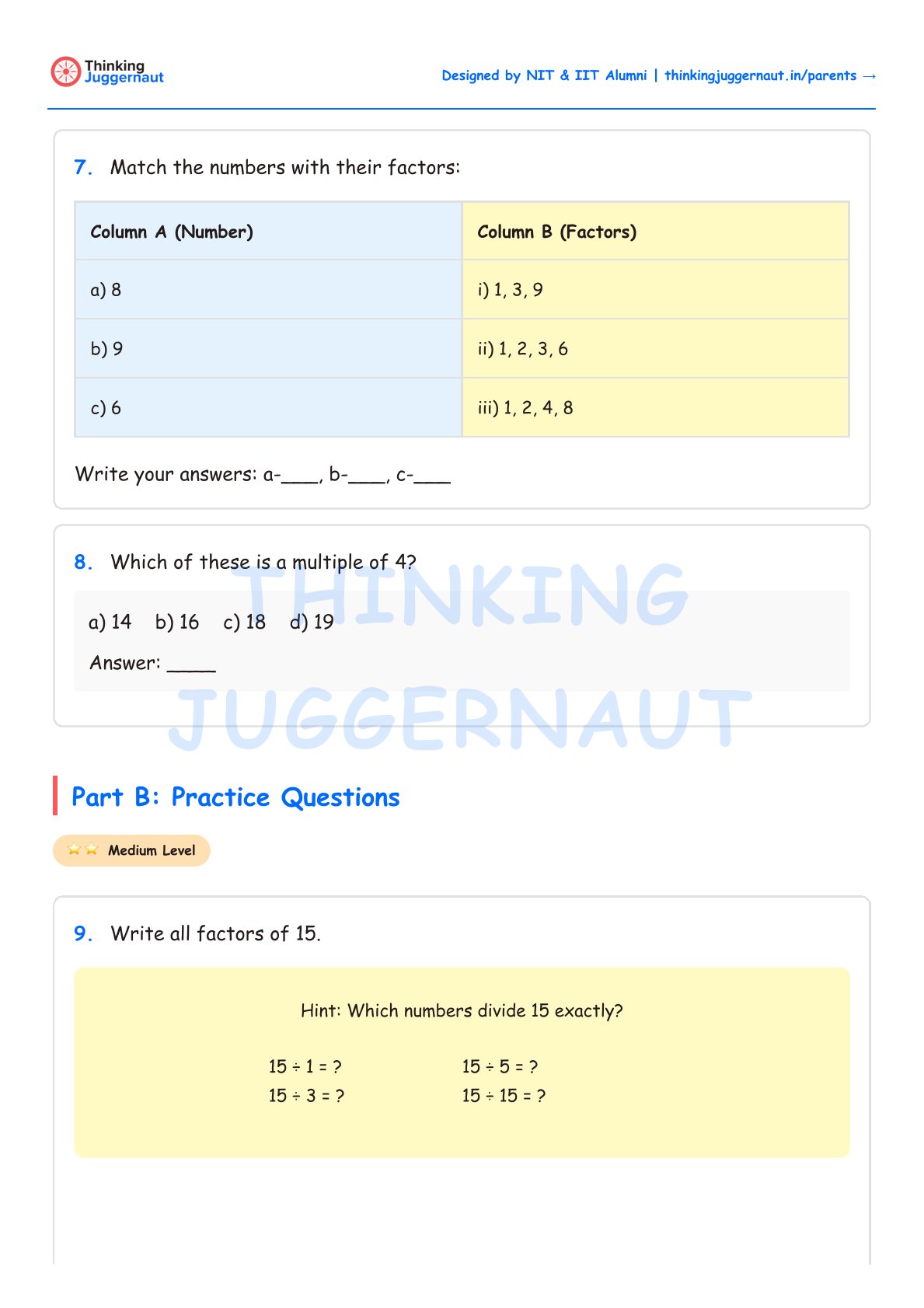
Write all factors of 6.
Write the first 5 multiples of 3.
Raj has 18 pencils. He wants to arrange them equally in rows. How many different ways can he arrange them?
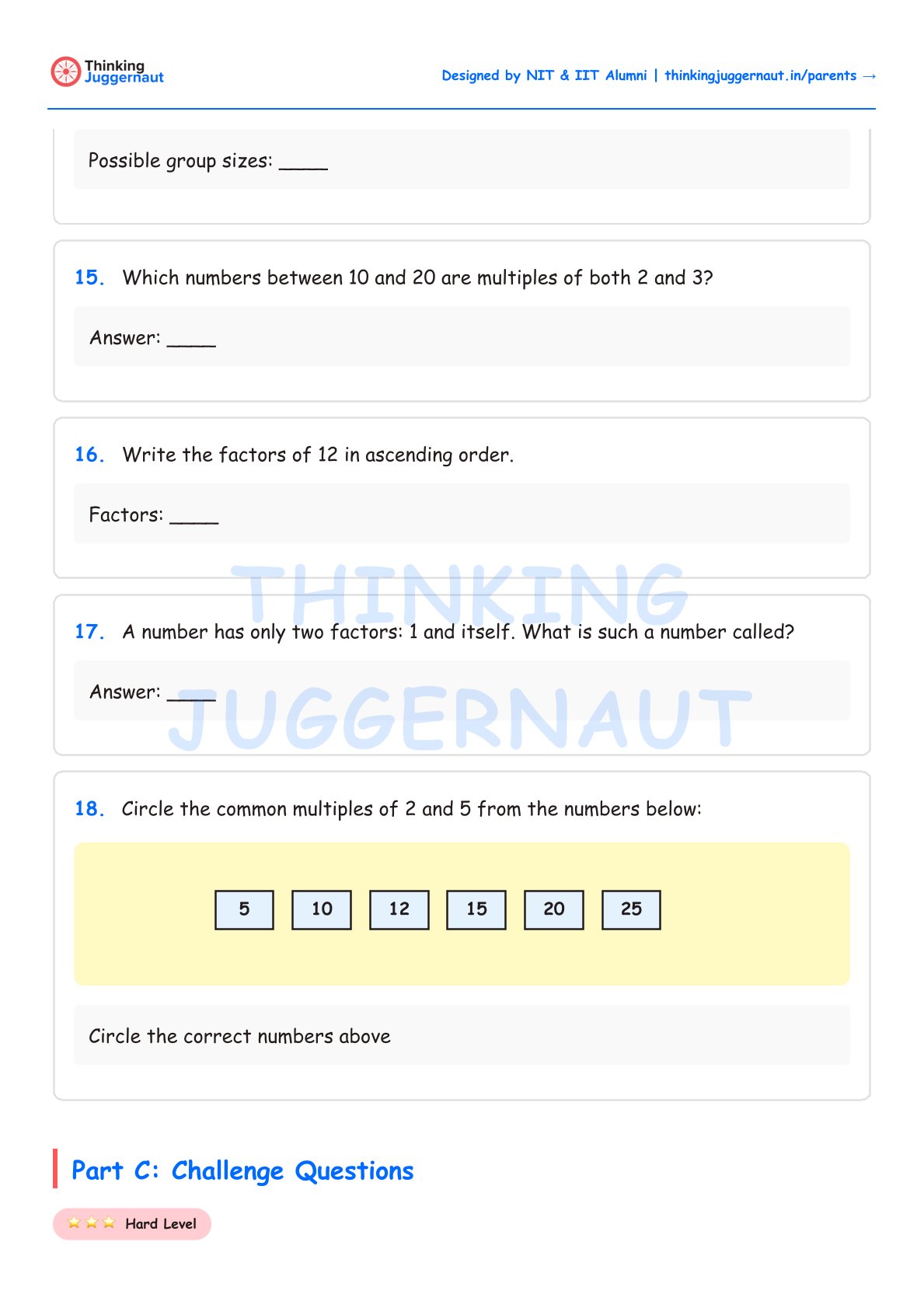
A teacher has 20 students. She wants to divide them into equal groups. List all the possible group sizes.
Which numbers between 10 and 20 are multiples of both 2 and 3?
A shopkeeper has 36 apples. He wants to pack them in boxes with equal numbers in each box. How many different packing options does he have?
Find the smallest number that is a multiple of both 4 and 6.
Meera is thinking of a number. It is a multiple of 5 and a factor of 30. What could the number be?
A farmer has 48 eggs. He wants to arrange them in trays where each tray has the same number of eggs (more than 2 but less than 10). How many different ways can he arrange them?
20-24 correct: Excellent! You're ready for prime and composite numbers, finding HCF and LCM, factor trees and prime factorization, and Class 5 advanced number theory concepts.
15-19 correct: Very Good! Practice finding factors of larger numbers (30, 40, 50). Work on identifying common multiples of two numbers. Practice more word problems. Create factor pairs.
10-14 correct: Good Effort! Make a factor chart for numbers 1-20 on paper. Write multiplication tables 1-10 to understand multiples better. Practice division facts to identify factors quickly. Use objects to group and understand.
0-9 correct: Keep Trying! Master multiplication tables 1-10 first. Understand division: 12 ÷ 3 = 4 means 3 is a factor of 12. Start with small numbers (6, 8, 10) to find factors. Use real objects to group and understand factors visually.
Write multiplication tables 2-10 daily and recite them
Practice division: For any number, divide by 1, 2, 3, 4... to find factors
Make a "Factor Finder Chart" for numbers 6, 8, 10, 12, 15, 18, 20
Remember: Factor × Factor = Number and Number ÷ Factor = Another Factor
Use factor pairs: For 20, write (1,20), (2,10), (4,5)
Find common multiples by listing: Multiples of 3 and 4 until you find matches
Key trick: To check if A is a factor of B, see if B ÷ A gives no remainder
Every number has 1 and itself as factors
Prime numbers have exactly 2 factors: 1 and itself
Class 4 Division
Class 4 Division Word Problems
Class 4 Perimeter and Area
Class 4 Decimals
Class 4 Data Handling
Class 4 Factors and Multiples
Class 4 Fractions
Class 4 Geometry
Class 4 Word Problems
Not in Class 4?
Visit our Main Math Worksheet Hub to explore all printable worksheets from Class 2 to Class 8.