Download free Class 4 division worksheet with answers. This comprehensive PDF includes practice problems covering long division method, division with remainders, division facts, pattern recognition, and real-world word problems. Features visual problem-solving examples, step-by-step long division breakdown, complete answer key, and performance assessment guide.
Division in Class 4
Division means splitting a number into equal groups. In Class 4, students advance to long division, a systematic method for dividing larger numbers.
Key Concepts:
Dividend - The number being divided (inside the division bracket)
Divisor - The number we divide by (outside the division bracket)
Quotient - The answer we get from division
Remainder - What's left over when division isn't exact
Division Formula - Dividend = (Divisor × Quotient) + Remainder
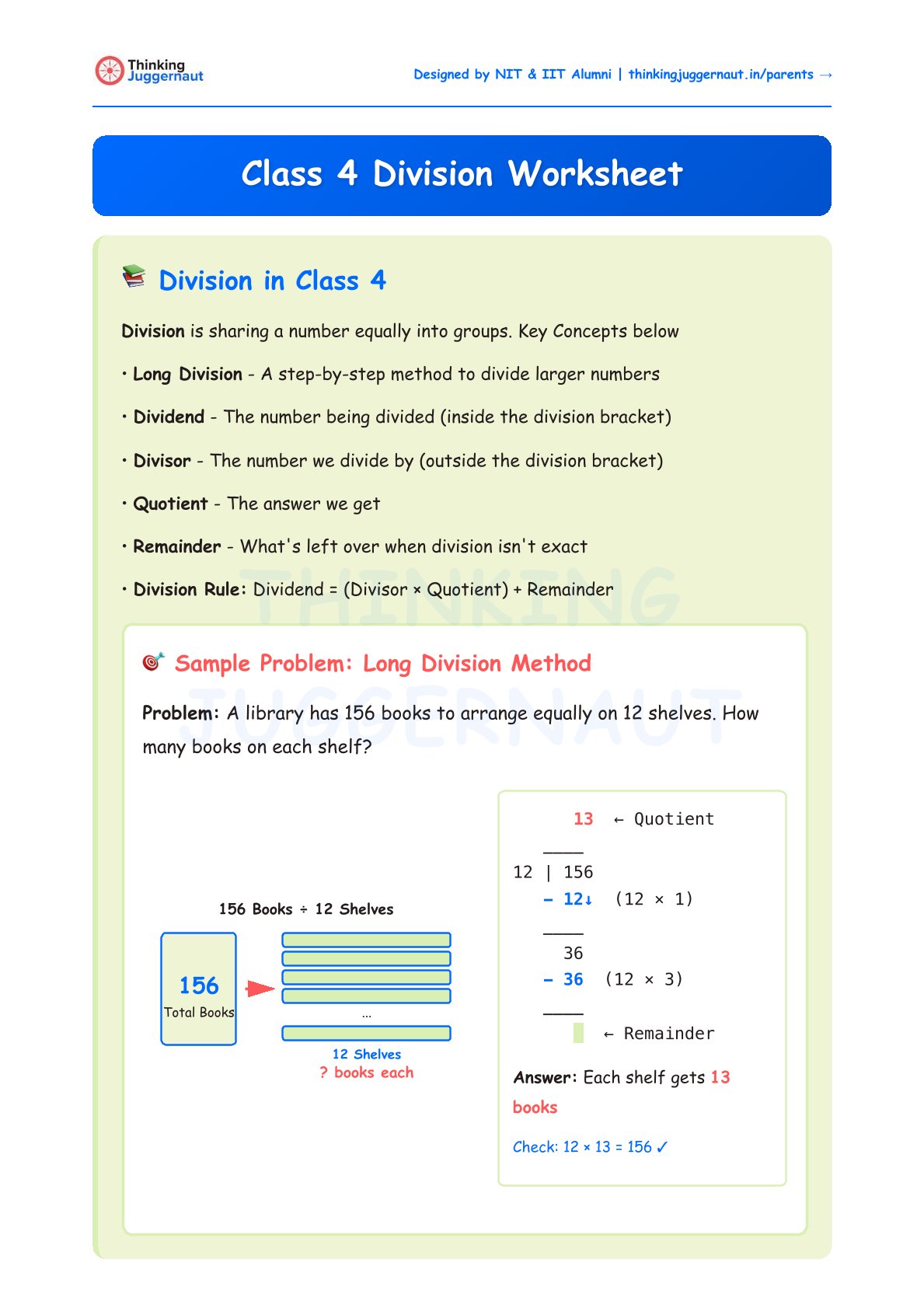
Example: In 156 ÷ 12, the dividend is 156, divisor is 12, quotient is 13, and remainder is 0.
Solved Example: Long Division Step-by-Step
Problem: A library has 156 books to arrange equally on 12 shelves. How many books go on each shelf?
Preview problem types included in the printable PDF:
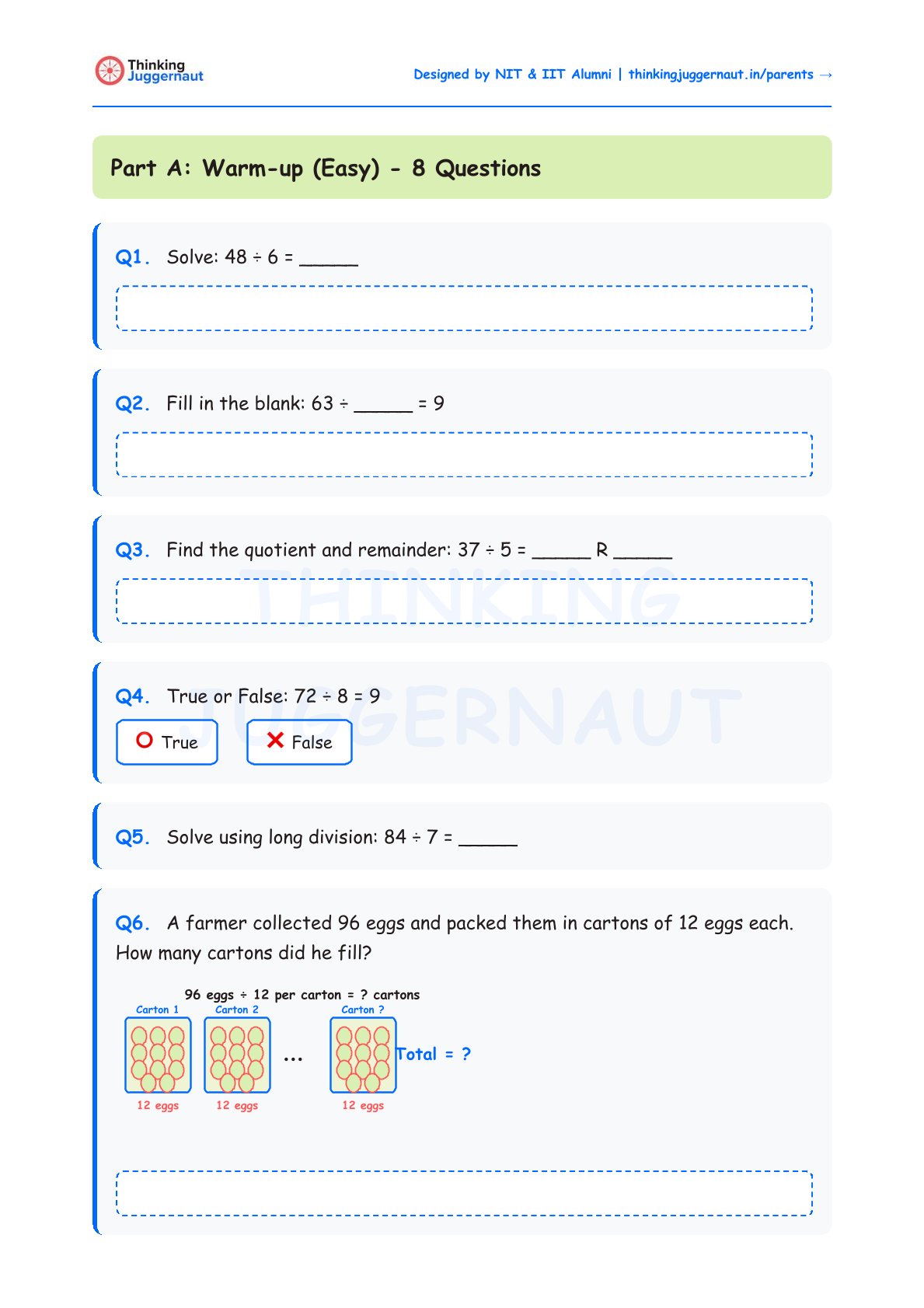
Basic Division: Solve 48 ÷ 6 = ____
Division with Remainders: Find quotient and remainder for 37 ÷ 5 = ____ R ____
Fill in the Blank: 63 ÷ ____ = 9
Word Problem with Visual: A farmer has 96 eggs and packs them in cartons of 12 each. How many cartons does he fill?
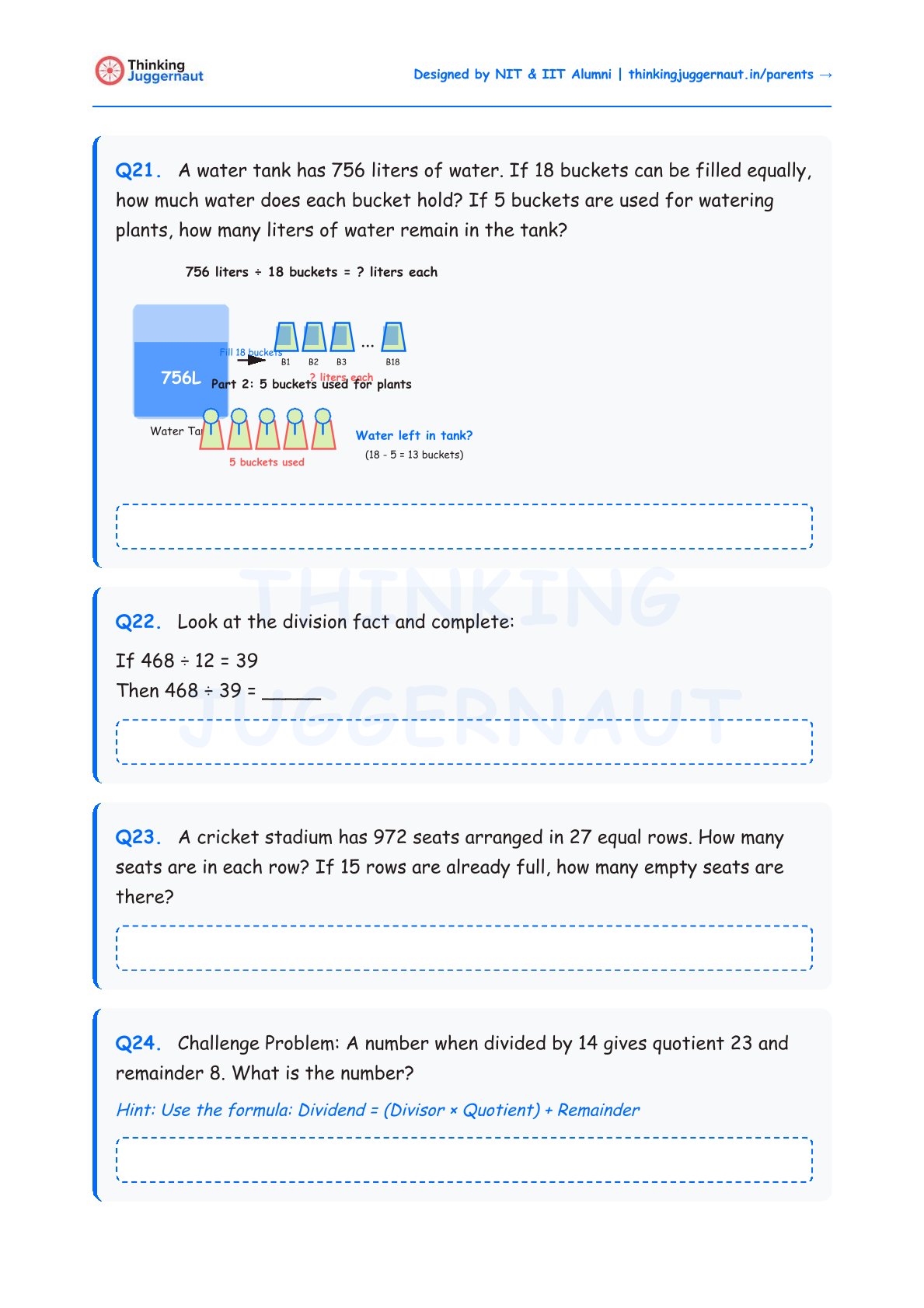
Multi-Step Challenge: A sweet shop has 864 laddoos packed in boxes of 24 each. After filling all boxes, if 3 are sold, how many remain?
Reverse Division: If 468 ÷ 12 = 39, then what is 468 ÷ 39?
Formula Application: A number divided by 14 gives quotient 23 and remainder 8. Find the original number.
Common Mistakes & Tips
Common Mistakes to Avoid:
Bringing Down Digits Too Early: In long division, students often bring down the next digit before completing the current step. Always multiply and subtract before bringing down.
Incorrect Placement of Quotient: When dividing 156 by 12, students might write the quotient digits in wrong positions. Each quotient digit should align with the dividend digit you're working with.
Forgetting the Remainder: In problems like 37 ÷ 5, students write just 7 instead of 7 R 2. Always check if there's anything left over.
Not Checking Answers: Students skip verification. Always check: (Divisor × Quotient) + Remainder should equal the Dividend.
Division by Zero Confusion: Some students think any number divided by zero equals zero or the number itself. Division by zero is undefined.
Top 5 Pro-Tips:
Use the DMSB Method: Divide, Multiply, Subtract, Bring down. Follow this sequence every time for long division accuracy.
Estimate Before You Divide: For 156 ÷ 12, think "12 times what is close to 15?" This helps you find the first quotient digit quickly.
Always Verify Your Answer: Use the division formula to check: (12 × 13) + 0 = 156. This catches calculation errors.
Practice Times Tables: Strong multiplication facts make division much easier. If you know 12 × 3 = 36 instantly, division becomes faster.
Remainder Must Be Smaller: The remainder must always be less than the divisor. If you get 37 ÷ 5 = 7 R 5, something's wrong because the remainder equals the divisor.
Assessing Learning: Scoring Guide
Total Questions: 24 | Total Marks: 24
Score: 22 – 24 (Outstanding! ⭐⭐⭐)
Next Step: You're a division master! Try Class 5 division with decimals or tackle more complex multi-step word problems.
Score: 18 – 21 (Excellent! ⭐⭐)
Next Step: Strong skills! Practice long division with larger numbers and focus on word problems to reach mastery level.
Score: 14 – 17 (Very Good! ⭐)
Next Step: Good foundation! Review the long division steps carefully and practice problems with remainders to improve accuracy.
Score: 10 – 13 (Good Effort! 💪)
Next Step: Focus on the DMSB method (Divide, Multiply, Subtract, Bring down). Practice with smaller numbers first, then gradually increase difficulty.
Score: Below 10 (Keep Trying! 📚)
Next Step: Build fundamentals first. Review multiplication tables, practice simple division facts, and work on division with single-digit divisors before attempting long division. Ask for help from a teacher or parent.