⭐ Answer Key included!
In Class 3, children work almost entirely with whole numbers. The jump to Class 4 introduces the decimal point — a small dot that changes everything about how numbers are read, compared, and calculated.
The single most important shift is this: digits to the right of the decimal point get smaller, not larger. In whole numbers, moving left increases value (ones → tens → hundreds). After the decimal point, moving right decreases value (tenths → hundredths). Children who apply whole-number intuition to decimals will consistently make errors — especially when comparing 3.7 and 3.25, where "25 looks bigger than 7" but 3.25 is actually smaller.
This worksheet is built to establish the correct intuition from the first question.
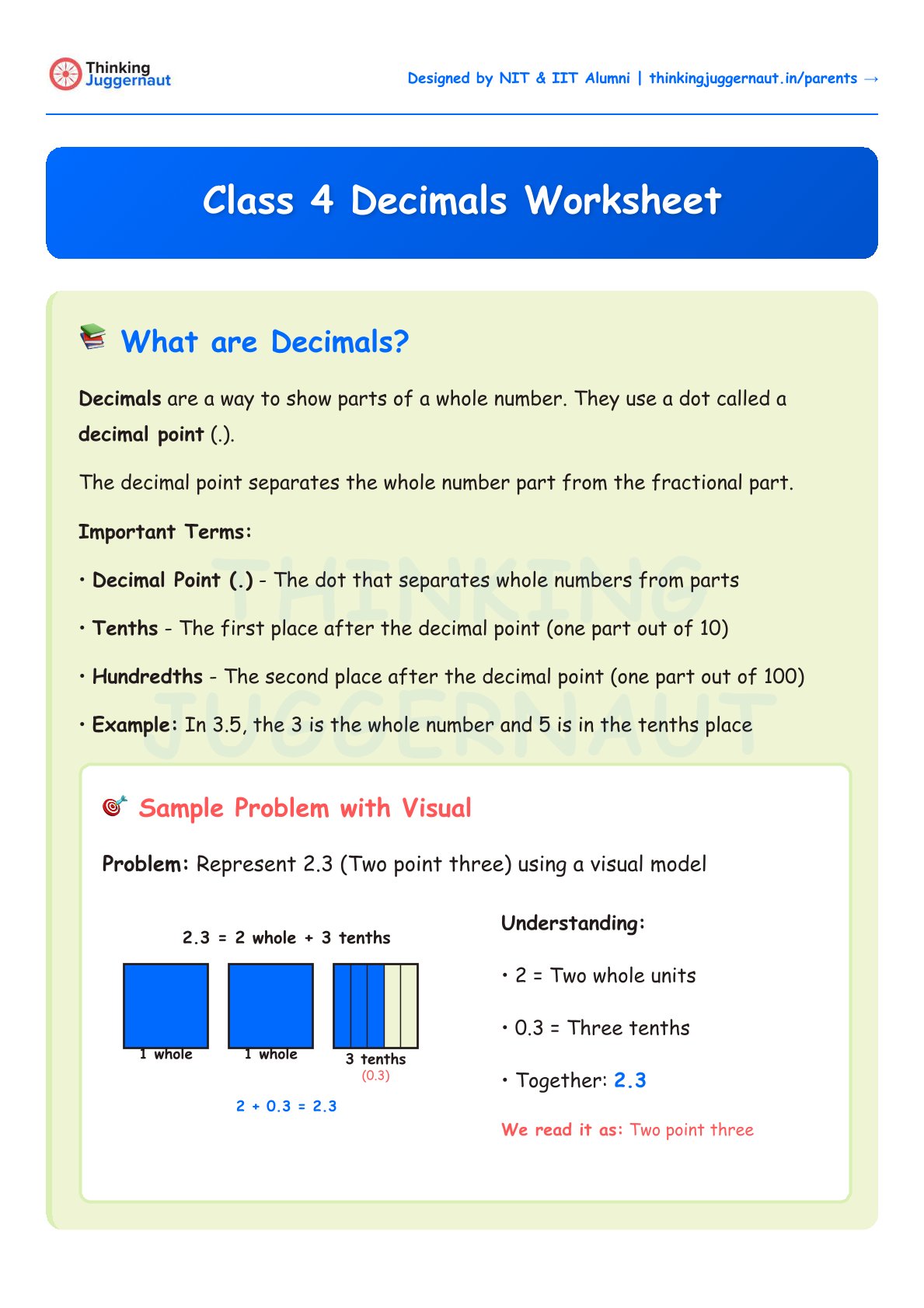
A decimal is a way of writing numbers that are between two whole numbers — numbers that include a part of a whole. The decimal point (.) separates the whole number on the left from the fractional part on the right.
Place value after the decimal point:
The first digit after the decimal point sits in the tenths place — it tells you how many tenths. In 3.5, the 5 means five-tenths, or five parts out of ten equal parts of a whole.
The second digit after the decimal point sits in the hundredths place — it tells you how many hundredths. In 3.52, the 2 means two-hundredths.
Reading decimals correctly: 3.5 is read as "three point five" — not "three and five" and not "three point fifty." Each digit after the decimal is read individually. 3.52 is "three point five two," not "three point fifty-two."
Decimals in daily life: Rupees and paise are the most natural decimal context for Indian children. ₹3.50 means 3 rupees and 50 paise — 3 whole rupees and fifty-hundredths of another rupee. Heights (1.2 m, 1.5 m), weights (12.5 kg, 7.8 kg), and distances (2.8 km, 3.5 km) all use decimals in the same way. This worksheet uses all four contexts across its 24 questions.
Problem: Represent 2.3 using a visual model and explain what it means.
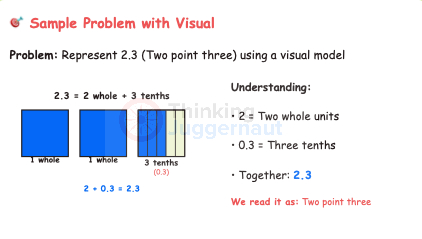
Solution:
Answer: 2.3 represents two complete wholes plus three-tenths of another whole.
Download the complete worksheet here. The PDF includes all 24 questions across 3 difficulty levels, visual decimal grid models, step-by-step diagrams for word problems, and a full answer key.
Is 0.8 greater than 0.5?
Yes. 0.8 means eight-tenths and 0.5 means five-tenths. Since eight-tenths is more than five-tenths, 0.8 > 0.5. The comparison works the same way as comparing 8 and 5 — as long as the place values are the same.
Is 3.25 greater than 3.7?
No. To compare, align the digits by place value: tenths first. 3.7 has 7 in the tenths place; 3.25 has 2 in the tenths place. Since 7 tenths > 2 tenths, 3.7 is larger. The hundredths digit (5) in 3.25 is irrelevant once the tenths digits differ. This is the most commonly missed comparison question at Class 4 level.
Is 4.7 the same as 4.70?
Yes. Adding a zero after the last digit in the decimal part (a trailing zero) does not change the value. 4.70 still means 4 wholes and 7 tenths — the zero in the hundredths place adds nothing. This is tested directly in Q12.
How do you add decimals without making mistakes?
Write the numbers one below the other with decimal points aligned vertically. Add column by column from right to left, exactly like whole number addition. The decimal point in the answer goes directly below the decimal points in the addends. If one number has fewer decimal places, add a zero to fill the gap (e.g., 3.5 + 1.25 becomes 3.50 + 1.25).
How do you subtract decimals?
Same principle as addition — align decimal points, add zeros if needed to make both numbers the same length, then subtract column by column. The hardest subtraction problems are ones where borrowing is needed across the decimal point, like 12.5 − 7.8.
What is the difference between tenths and hundredths?
Tenths divide a whole into 10 equal parts — one-tenth is 0.1. Hundredths divide a whole into 100 equal parts — one-hundredth is 0.01. One-tenth equals ten-hundredths: 0.1 = 0.10. ₹1 divided into 10 equal parts gives 10 paise each (tenths). ₹1 divided into 100 equal parts gives 1 paise each (hundredths).
Decimals are not just a Class 4 topic — they are the language of measurement. The Applied Maths Project Kit by Thinking Juggernaut includes activities where children measure lengths, compare quantities, and calculate with real numbers that naturally involve decimals.
Part A – Warm-Up (Easy ⭐) — 8 Questions
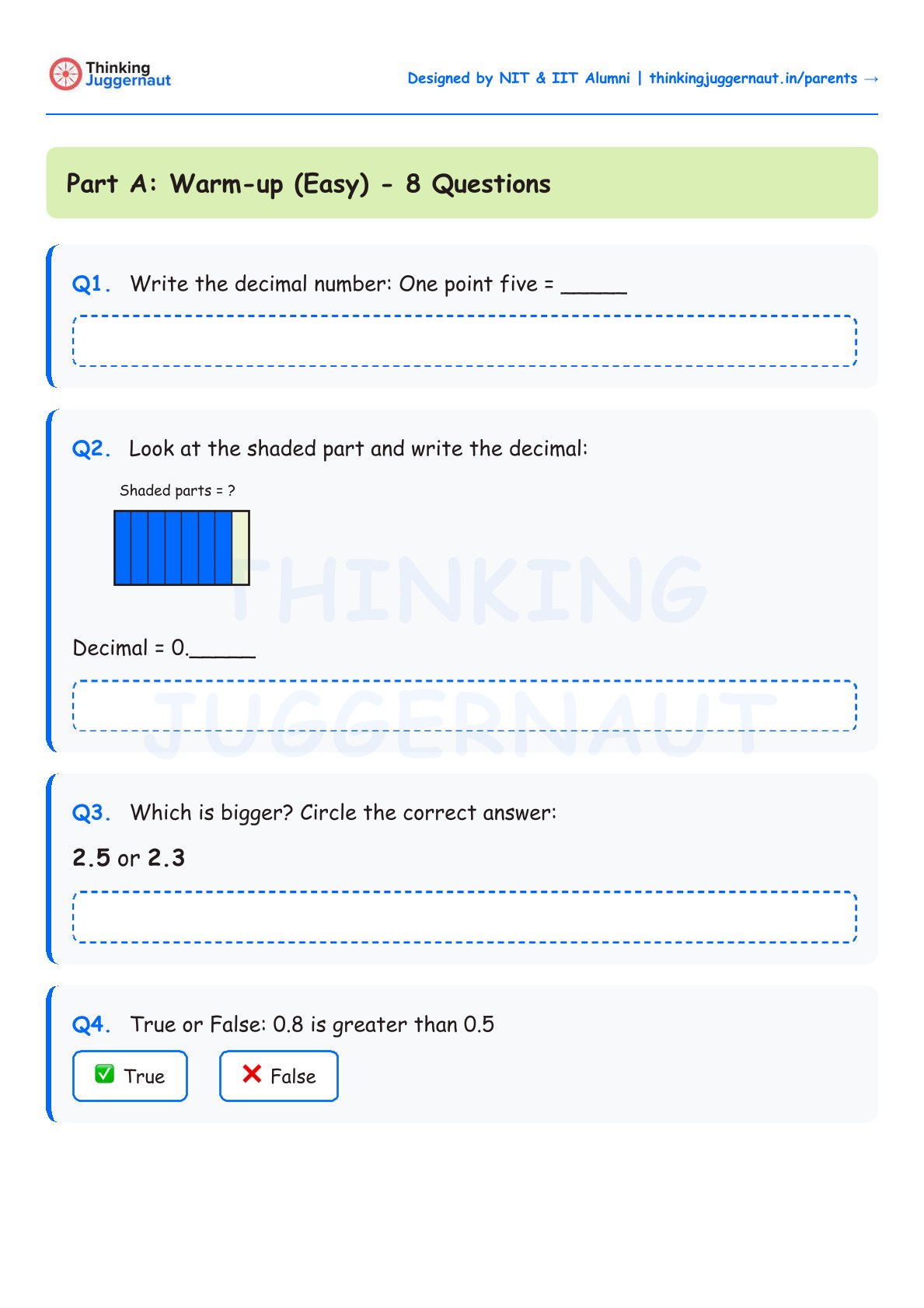
Direct reading, writing, and comparing of simple one-decimal-place numbers. Children write decimals from words, read shaded grids, circle the larger of two decimals, and convert between expanded form (4 + 0.6) and decimal notation (4.6). No calculation required — this section tests whether the foundational reading of decimals is in place before any arithmetic begins.
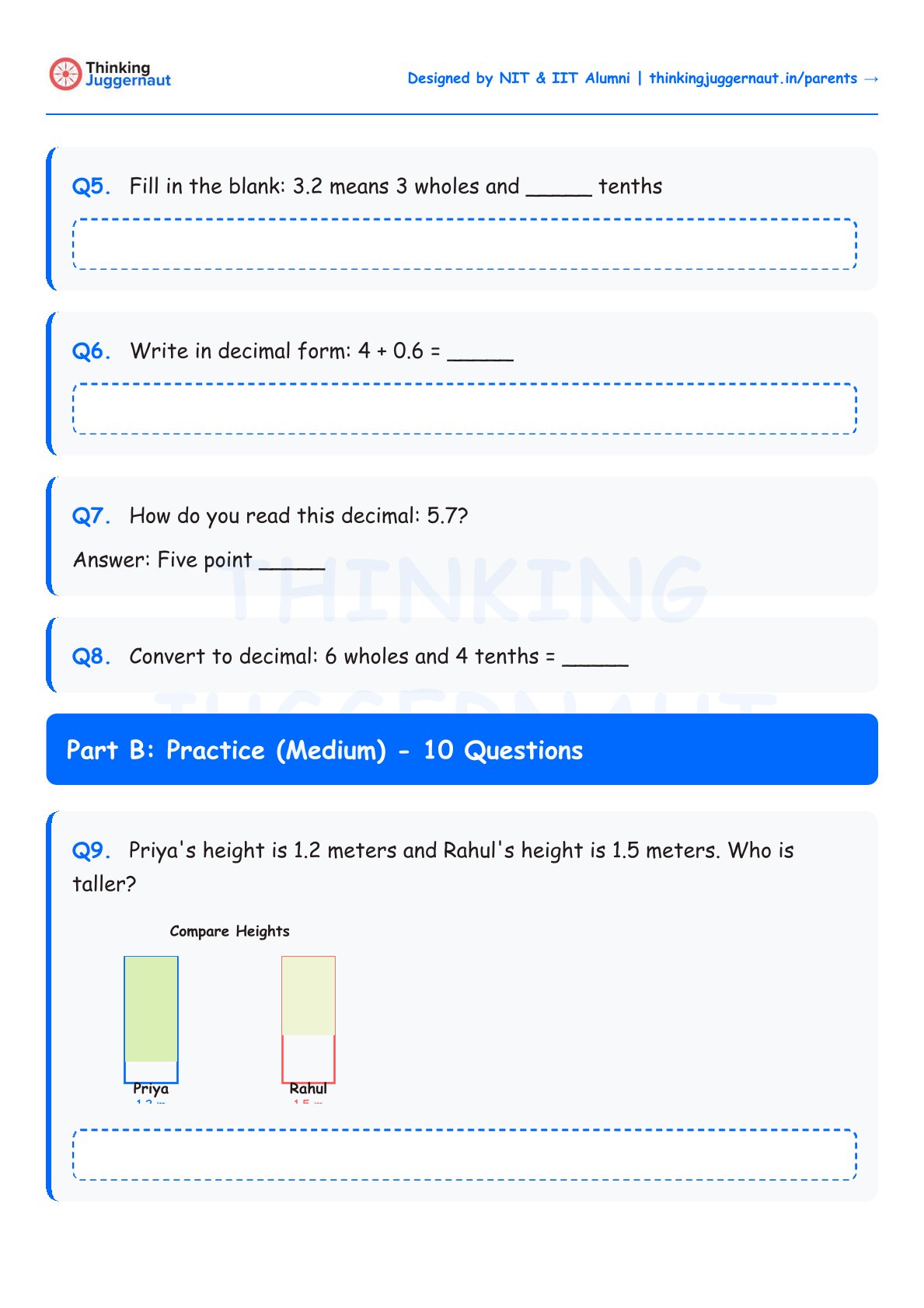
Sample: Fill in the blank: 3.2 means 3 wholes and ___ tenths.Sample: Which is bigger — 2.5 or 2.3?
Part B – Practice (Medium ⭐⭐) — 10 Questions
Introduces addition, subtraction, ordering (ascending and descending), comparison using >, <, =, and two single-step word problems — one using heights (metres) and one using money (rupees). Also includes a true/false on trailing zeros (Q12) and a column matching exercise linking decimals to their word forms.
Sample: Rohan ran 2.8 km on Monday and 3.5 km on Tuesday. How many kilometres in total?Sample: Arrange in ascending order: 3.7, 3.2, 3.9, 3.5
Part C – Challenge (Hard ⭐⭐⭐) — 6 Questions
Multi-step word problems using weight (kg of apples), length (rope cutting), and money (three-item grocery bill). Includes adding three decimals in sequence, a reverse problem (find how much was added to reach a known total), and ordering four decimals in descending order. The grocery bill problem (Q22) is the most complex: three different prices to add, two involving hundredths, giving a total in rupees and paise.
Sample: Meena bought milk for ₹25.50, bread for ₹18.75, and butter for ₹45.25. What is the total cost?Sample: A water tank has 15.4 L. After adding water it has 23.7 L. How many litres were added?
Common Mistakes to Avoid:
Top 5 Pro-Tips:
Total Questions: 24 | Total Marks: 24
Score: 20 – 24 (Excellent! ⭐⭐⭐)
Score: 15 – 19 (Very Good! ⭐⭐)
Score: 10 – 14 (Good Effort! ⭐)
Score: 0 – 9 (Keep Trying! 💪)
With whole numbers, more digits always means a larger number. With decimals, this rule breaks down — 3.7 has fewer digits than 3.25 but is larger. Children who have internalised "more digits = bigger number" need to explicitly unlearn this rule for decimals. The fix is column-by-column comparison starting from the leftmost digit, which works for both whole numbers and decimals.
Money (₹ and paise) is the most intuitive because children encounter it daily. Height measurement in metres (1.2 m, 1.5 m) is excellent for comparison problems. Weight in kilograms (12.5 kg) and distance in kilometres (2.8 km) work well for addition and subtraction. This worksheet uses all four contexts deliberately so that children see decimals as a general-purpose tool rather than a classroom-only concept.
Worksheets build practice. The Applied Maths Project Kit builds understanding covering the same concepts your child is practising here. A hands-on math kit inspired by NEP 2020’s vision of learning mathematics as thinking, connecting, and applying, not just solving equations.


Designed by IIT & NIT Alumni · NEP-2020 aligned · Trusted by parents across India
Not in Class 4?
Visit our Main Math Worksheet Hub to explore all printable worksheets from Class 2 to Class 8.