3:2. 5:6. 4:3. Ratios are everywhere — in recipes, cricket teams, paint mixing, classroom splits, and price comparisons — but most children first meet them as a maths concept with no obvious connection to anything real.
This worksheet covers:
24 questions | 24 marks | Printable, A4 size | No sign-up needed
A ratio compares two or more quantities of the same kind.
For example: If there are 3 apples and 5 oranges, the ratio of apples to oranges is 3:5 (read as "3 is to 5")
Order matters: Ratio 3:5 is different from 5:3
Same units: We can only compare quantities with the same units (apples to apples, not apples to oranges' weight!)
Simplest form: Like fractions, ratios can be simplified (4:8 = 1:2)
Three ways to write: 3:5 or 3 to 5 or 3/5
Classroom: 15 boys to 18 girls (ratio 15:18 = 5:6)
Colors: Mixing 1 part blue to 2 parts yellow makes green (ratio 1:2)
Problem: In Rahul's fruit basket, there are 6 mangoes and 9 bananas. Find the ratio of mangoes to bananas and simplify it.
Solution:
Number of mangoes = 6
Number of bananas = 9
Ratio of mangoes to bananas = 6:9
Simplifying:
Both 6 and 9 are divisible by 3
6 ÷ 3 = 2
9 ÷ 3 = 3
Answer: The ratio in simplest form is 2:3
Write the ratio of stars to hearts from a visual representation
Simplify the ratio: 10:15
A cricket team has 11 players. 6 are batsmen and 5 are bowlers. Find the ratio of batsmen to bowlers.
In Priya's garden, there are 15 rose plants and 20 tulip plants. What is the ratio of roses to tulips in simplest form?
A recipe uses milk and water in the ratio 3:2. If you use 6 cups of milk, how many cups of water do you need?
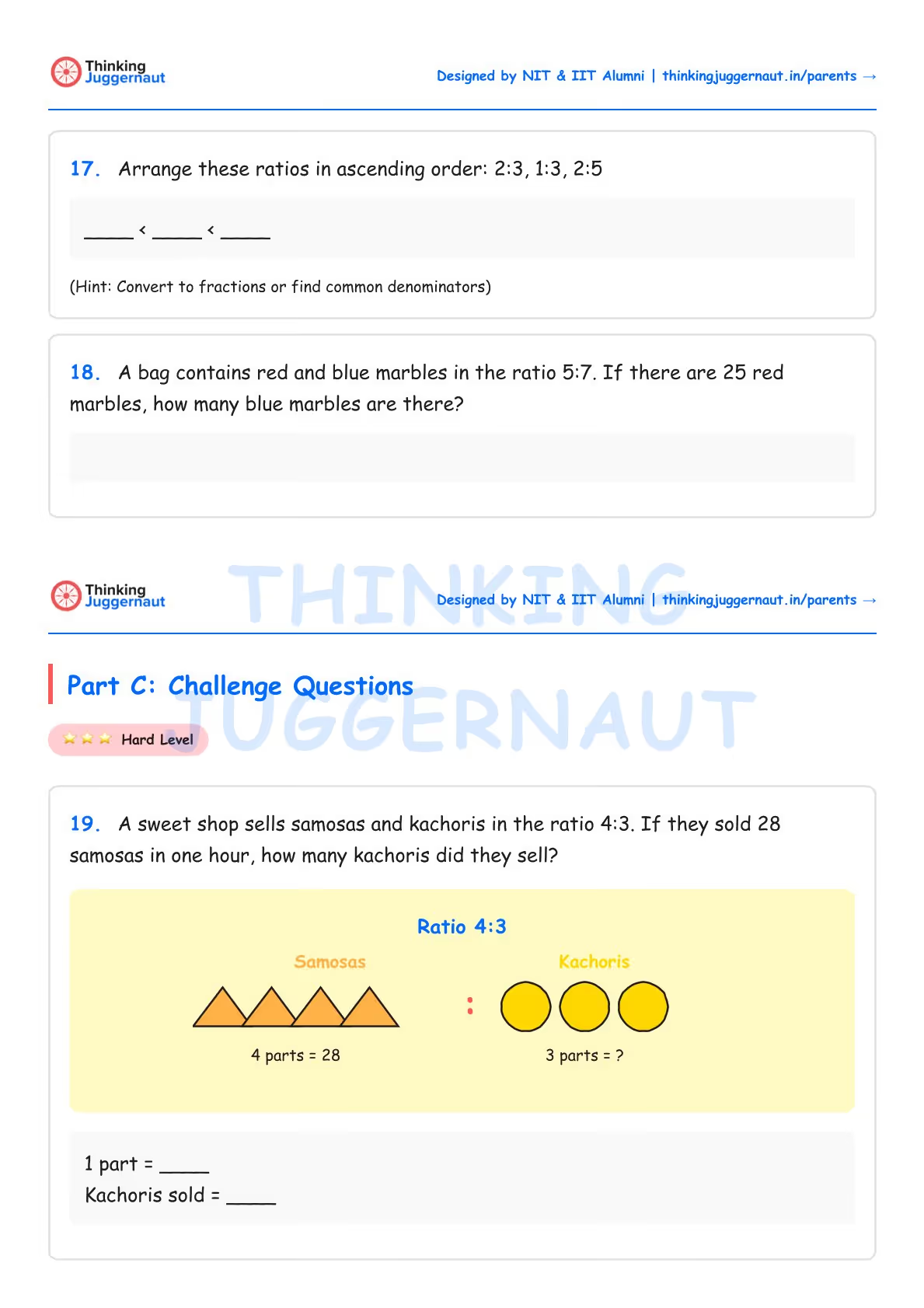
A sweet shop sells samosas and kachoris in the ratio 4:3. If they sold 28 samosas in one hour, how many kachoris did they sell?
20-24 correct: Excellent! You're a ratio master! Try solving problems with three-term ratios (like 2:3:5).
15-19 correct: Very Good! Great work! Practice more word problems that require finding unknown quantities.
10-14 correct: Good Effort! Keep practicing! Focus on simplifying ratios and understanding the relationship between parts.
0-9 correct: Keep Trying! Review the concept section. Practice finding ratios from pictures and simplifying them daily.
Always simplify: Divide both parts by their HCF (like 10:15 becomes 2:3)
Order matters: Remember 3:5 is different from 5:3
Find the value of 1 part: In word problems, divide the given quantity by its ratio part
Check total parts: When given total, add ratio parts (3:5 means 8 total parts)
Use multiplication: Once you know 1 part, multiply to find other quantities
Practice with real objects: Use marbles, candies, or toys to visualize ratios
Forgetting to simplify the final answer
Mixing up the order (writing 5:3 instead of 3:5)
Not finding the value of 1 part in word problems
Adding ratios incorrectly (2:3 + 1:2 ≠ 3:5)
These three topics look different on paper but they are all doing the same thing: comparing a quantity to something else.
A ratio compares part to part. If a class has 15 boys and 18 girls, the ratio of boys to girls is 15:18, simplified to 5:6. It says nothing about the total — only how the two groups relate to each other.
A fraction compares part to whole. The same classroom has 33 students total, and 15 are boys, so the fraction of boys is 15/33, simplified to 5/11. Now the total matters.
A percentage takes that fraction and expresses it out of 100. 15/33 is approximately 45.5% — meaning roughly 45.5 out of every 100 students in a room like this would be boys.
Same classroom. Same numbers. Three different ways of describing the relationship depending on what the question is asking.
Worksheets build practice. The Applied Maths Project Kit builds understanding — 30 real-world math activities covering the same concepts your child is practising here, from multiplication and grouping to measurement and data.
Designed by IIT & NIT Alumni · NEP-2020 aligned · Trusted by parents across India
Class 5 Decimals
Class 5 Fractions
Class 5 Percentage
Class 5 Basic Algebra
Class 5 Data Handling
Class 5 Geometry
Class 5 Ratio
Not in Class 5?
Visit our Main Math Worksheet Hub to explore all printable worksheets from Class 2 to Class 8.
Almost there!
We will confirm your order on WhatsApp
Order placed!
Thank you! You will receive a WhatsApp confirmation shortly.